What can we do as procurers of goods to prevent future factory disasters in developing countries?

By Karen Bowman, University of Edinburgh Director of Procurement

A number of recent fires and factory collapses in Asia have resulted in the killing and maiming of thousands of workers. Such human abuse and horrific disaster is surely a wake-up call for improving standards for garment workers, and indeed all workers. While these disasters may not have occurred in factories that are part of our University’s supply chains, we need to find ways to use our roles as procurers of goods to prevent such tragedies in future.

In attempt to begin to address such issues, we are already tapping into a range of initiatives which focus on workers’ welfare and rights. We are a Scotland’s first Fairtrade University (and indeed Scotland has now become a Fair Trade Nation), buying fair trade products where possible. We are part of the Worker Rights Consortium (WRC), which sends us ‘abuse’ reports about garment factories (mainly for USA college-branded goods). Our universities and colleges procurement centre of expertise, APUC Ltd, is developing a sustainable supply chain policy and code of conduct, with input from the National Union of Students (NUS), People & Planet, myself, and peers at Aberdeen University and Environmental Association of Universities and Colleges (EAUC). However, we know research indicates that such ‘codes’ alone have limited effect.

WRC’s latest report on the recent factory collapse in Bangladesh says amongst other things ‘…what is needed in Bangladesh is a nationwide program of factory renovations and repairs to convert unsafe structures into buildings that are fundamentally safe for workers. This must be funded in substantial part by higher prices to factories from brands and retailers.  The WRC helped to develop a binding, enforceable fire and building safety agreement under which such a program would be carried out and we continue to urge brands and retailers to sign it.”

Signing a code or even a ‘binding agreement’ is just the start. Surely the only way to make a significant difference is to research, develop and deliver on ‘fair trade and global justice’. A research-led approach needs to identify what practices should be endorsed and implemented, monitored and audited, and we should demand at the very least our own contracted suppliers and service providers work with universities to access the latest research and best practice.

We have recently created a Fair Trade Academic Network and a Global Justice Academy here, and I would welcome their help to see if the University can shed even a little light on how best we in the rich ‘buying’ part of the globe can really make some real and lasting progress on standards for those in the poor ‘producing’ countries, so that this kind of abuse and horrific disaster becomes historic and not a recurring part of world trade and globalisation. Slavery was stopped (well almost) by political and consumer revulsion.

For more discussion or to learn about our fair trade university policy or academic network, feel free to contact liz.cooper@ed.ac.uk, University Fair Trade Coordinator.

Should we support industrial use of prison labour?

Whether prison labour is, and whether it should be, used in university supply chains are questions that have arisen in a number of contexts in recent weeks. When asked my opinion on the use of prisoners to manufacture goods, I realised I was yet to form a strong view on the issue – immediately seeing arguments for (such as in the potential for rehabilitation and training for the outside world), and against (the potential for exploitation and profiteering of cheap labour by private firms). Seeing that this issue provoked similar confusion among colleagues, I have carried out some preliminary research in order to bring associated ethical and practical questions to the attention of students and staff. It is not clear whether prison labour (overseas or in the UK) is a feature of any of the supply chains we work with at present, as there is a lack of transparency with regards to product flows. However, it is clearly appropriate for a university such as ours, with a strong focus on fairness in trade (see http://www.ed.ac.uk/about/sustainability/fairtrade and our Fair Trade Academic Network), to reflect on whether we should be actively supporting, or attempting to ban, prison labour in our supply chains.

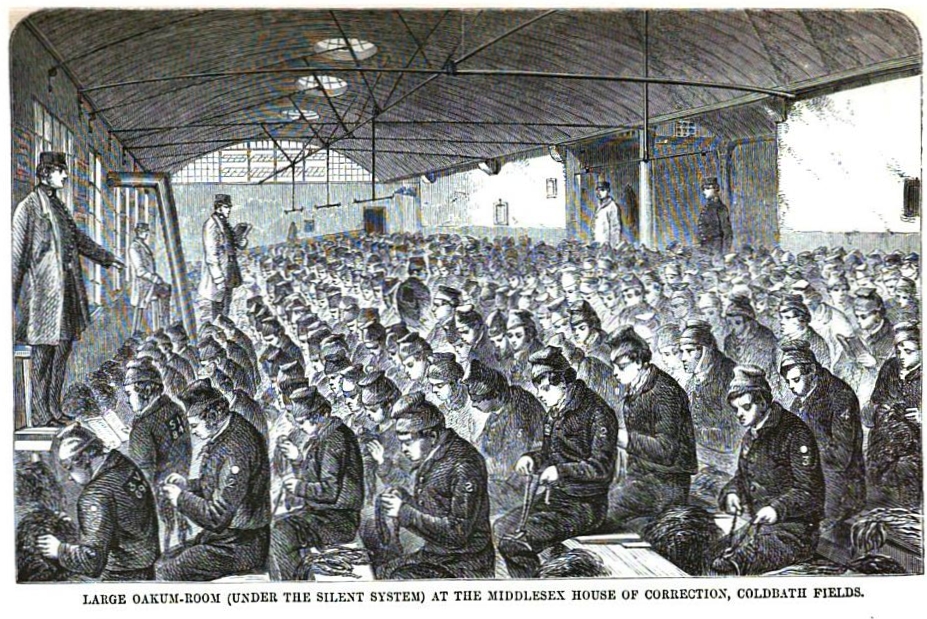
My short desk-based study identifies motives behind making prisoners work. These include punishment, rehabilitation, and to save or make money. In the 19th century there was a shift in Western prisons from labour as punishment, to useful work, such as laundry or cooking. Prisoners were working to cover some of the costs of their incarceration. There has been a further shift in two waves – initially at the time of the industrial revolution, and again in recent decades dominated by neoliberal ideology, from cost-saving, to profit-making work. Prisoners have been forced or incentivised, depending on context, to manufacture goods for prison-owned industries and for private firms. Numerous authors argue that manufacturing in prisons has been used as a means of preparing disciplined, obedient workers, prepared to take low-paid jobs on release. In addition, private firms using prison labour have been able to benefit from low wages and reduced costs, as supervision and space are provided by the state. Questions are raised about whether manufacturing work carried out behind bars has detrimental effects on labour markets outside prisons.

Coldbath-fields-oakum-room-mayhew-p301

In recent decades, in the UK in particular, the discourse among policy makers and prison officials has focused on work as rehabilitation. There are some examples of prisoners being trained in meaningful work, which relates to contemporary job markets, yet in many cases prisoners are found to be performing mundane, unskilled tasks. Overall there appears to be a lack of transparency regarding what work is carried out, and for whom.

Being a Fairtrade University, and one that is committed to exploring all avenues for trading fairly, I have considered to what extent prison labour could fit within a fair trade paradigm. Concepts of fair trade typically call for reasonable compensation for work carried out, decent working conditions, the right to freedom of association, and the provision of training opportunities. Whether and how much prisoners should be paid for work is complex. Currently most prisoners working around the world are paid small amounts, more as a form of pocket money to contribute to non-essential purchases. There are calls for prisoners to be paid national minimum wage levels, but most consider it fair to deduct proportions of such a salary to cover food and accommodation provided by prisons, and also for victim compensation. In terms of working conditions, evidently these vary, and prisoners are not able to join unions in order to voice concerns about conditions. As for training opportunities, as discussed above, while these are often made available in Western prisons, their relevance to potential jobs for prisoners once their sentences are over is often questioned. In addition, it is often unclear as to whether prison labour is forced or voluntary. In the UK, work is linked to an incentives scheme, but prisoners can be punished for not working. In several US states, full working weeks are overtly obligatory. Whether and how prison labour can be fair is clearly an area for further research.

My paper which deals with these issues in a little more detail and provides a list of questions to be explored further can be found here. Please share, discuss and comment on this post, in order to help stimulate the debate. We are looking into organising an event on prison labour in the coming months.

Liz Cooper
Fair Trade Coordinator

Climate Change and Me

I know this is a problem of unprecedented gravity, but what should I be doing about it? As individuals in the era of global climate change, each of us faces this dilemma.

We face it all day, every day. If I’m cold, do I turn up the central heating? If it’s quicker and cheaper to drive, should I get the bus? We face it even assuming that we are already committed to doing something: that we are motivated to act as we ought on climate change, however that might turn out to be. Should I fly to international summits to protest at intergovernmental failure to curb emissions, or stay at home and save the air miles? Should I direct my charity donations to the victims of a tsunami in Bangladesh, or to international activist efforts such as those of Greenpeace?

This sense of bewilderment – of individual powerlessness – is what prompted me to write my book Climate Change and the Moral Agent. But to answer such questions, I think we need first to address a philosophically bigger one: why should we be doing anything at all? If what each of us does would be harmless in isolation and if we are not acting intentionally collectively, at a global level, so as to bring about the harm, where do my climate duties come from? Many of us feel sure that we have them, but it takes an expansion of standard moral thinking to explain why.

I begin, then, with this broader challenge. I defend what I call a weakly collective duty, requiring us to organize at a global level to mitigate climate change, to enable adaptation, and to provide compensation. This organization might be via existing institutions, but equally we might have to cooperate to bypass them and perhaps ultimately create new ones. Such a duty can be grounded in at least four ways.

Firstly, for younger generations, mitigation is a matter of moralized collective self interest. It would be to the fundamental advantage of each of us, but can only be secured collectively, so we can be said to owe it to one another.

Secondly, many would accept that individuals or organized groups have a duty to prevent serious suffering if they can do so at less than significant cost to themselves. This is known as the principle of beneficence. Others – including Virginia Held, Larry May, Robert Goodin and Henry Shue – have extended this to cases where we are not yet a group capable of collective action but could become so in time prevent the suffering. On such reasoning, the affluent, wherever they are in the world, should organize to secure climate change mitigation and adaptation.

The third argument rests on a principle even harder to deny than that of beneficence. This is the no-harm principle, which requires us not to do serious, foreseeable harm to other human beings. I contend that this, too, should be collectivized. While not individually responsible – or even necessarily blameworthy – we are weakly collectively responsible for serious harm resulting predictably from our combined individual actions. Given this, as polluters we have a stringent duty to organize to secure climate change mitigation, adaptation, and compensation.

In this context, let us return to the well-intentioned but perplexed individual. The question is not simply: what should I be doing about climate change? It is rather: given what we should be doing, but are not, what is my primary moral duty?

My book considers three options. We might have mimicking duties, to do what we would have had to do if there were a fair, effective collective scheme in place to fulfil the weakly collective duty. Individual emissions cuts are the obvious example. We might have promotional duties, to try to bring about collective action. Or we might have duties to aid victims or to mitigate the harm directly.

Mimicking duties have widespread appeal. In particular, there is strong intuitive force – brought out in Liam Murphy’s compliance condition – to the view that it is unfair to ask more of anyone than she would have to do if everyone else were cooperating. However, I consider various possible philosophical arguments for mimicking, including appeal to consequentialism, to Kantian reasoning, and to virtue ethics. None convincingly demonstrates that mimicking is all, or even the first thing, that is required of us, against the background of a weakly collective duty. Instead, considerations of effectiveness, efficiency and fairness put the primary emphasis on promoting collective action, supplemented by fulfilling direct duties.

That’s not to say that we should not be doing the things conventionally thought of as ‘green’. Individual emissions cuts can be a necessary part of promoting wider level change, not least because many people, unswayed by abstract philosophical reasoning, would perceive an individual who did otherwise to be hypocritical. There might also be a character-based case for such actions, where they don’t conflict with fulfilling promotional or direct duties. But they are very far from all that can be asked of us and they do not take priority in cases of such conflict.

Of course, there are limits to what any of us can do without significant sacrifice. In saying that we should act otherwise than might be required if there were an effective global scheme in place, I do not suggest that we should give up everything. I am not acting wrongly because I do not put myself absolutely on the breadline or abandon my family in pursuit of collective action on climate change, although I might reasonably be blamed for not giving up my Starbucks cappuccino habit in order to promote it.

However, it is the fact that climate change can present us with such choices at all that prompts my fourth moral case for collective action. Even if we can’t be blamed for how we respond in these extreme scenarios – and most of us, of course, never get anywhere close to them – they are hard to live with. The truly motivated individual would face a more or less constant tug of war between central elements of her own life, her own relationships, and the moral pull on her of the very great harms for which she is one of those weakly collectively responsible. Given that this unhappy situation is collectively avoidable, we acquire a weakly collective duty to ourselves, as both moral agents and human beings, to organize to make it simultaneously possible to tackle climate change and fully to pursue our own lives and relationships.

EC