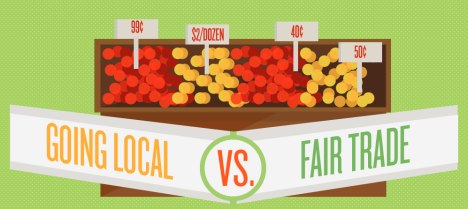
The term fair trade has been appropriated by organisations and businesses working on improving livelihood opportunities and working conditions in developing countries. It is about connecting poor farmers and manufacturers to international marketing channels, and applying ethical standards to trade relations. Fair trade is now almost exclusively understood to be about goods imported from afar. Alongside fair trade, a growing ‘buy local’ movement advocates consumption of locally produced and locally manufactured goods, aiming (among other things) to cut carbon emissions by reducing shipping distances, and to develop local livelihoods and communities. People concerned about the social and environmental consequences of their purchasing decisions are increasingly wondering whether to choose fair trade, or choose local. Indeed this Christmas in Edinburgh, fair trade groups are calling for people to have a ‘fair trade Christmas’, while signs have popped up on the streets advising people to ‘buy local this Christmas’. Continue reading
Does Scotland have a right to secede?
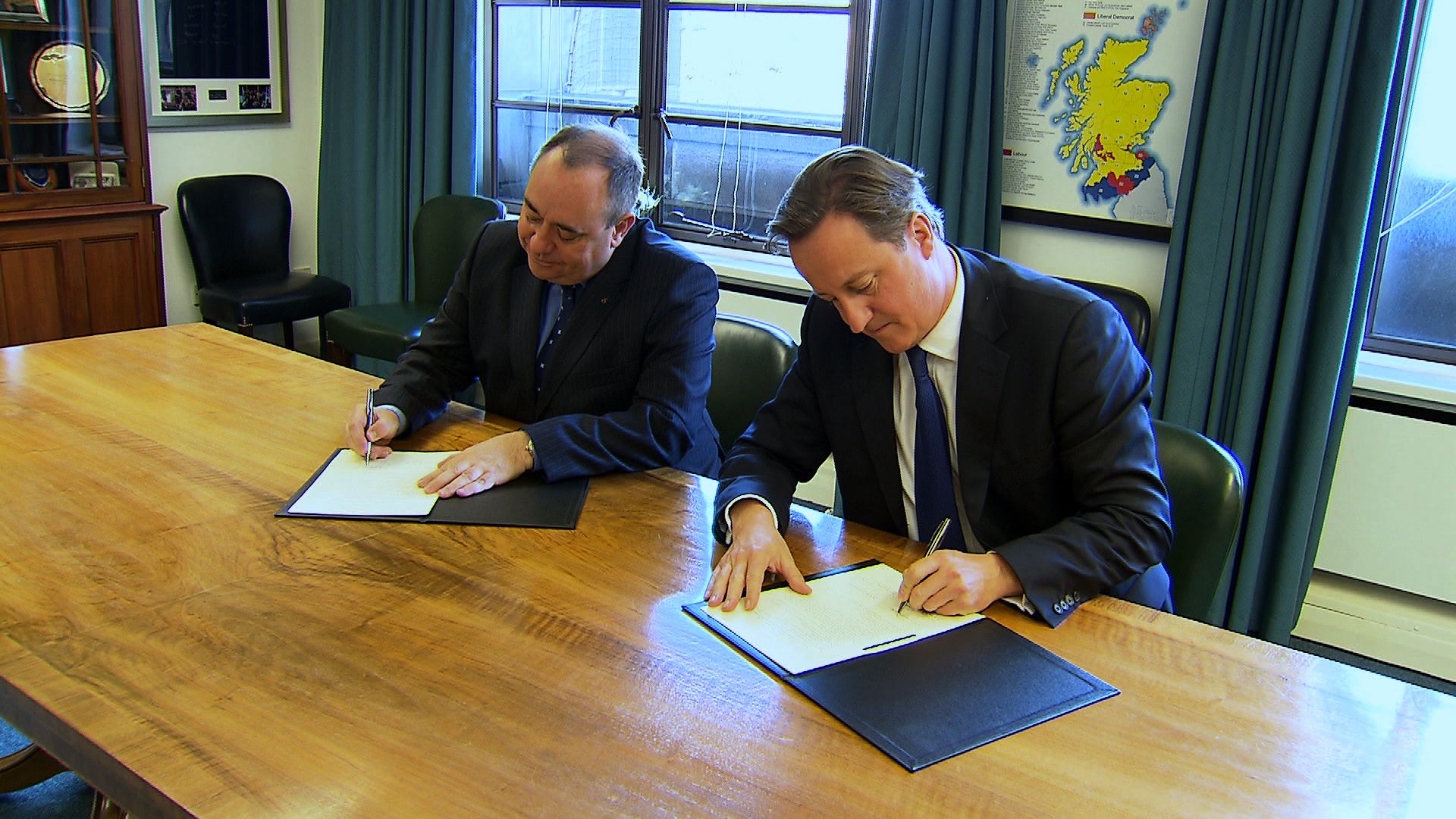
What is perhaps most striking about the debate regarding Scottish independence is not what people are saying but what they are ignoring. When one brings the philosophical literature on secession to bear on the public debate one notices that a number of points are being assumed that require defence. In this article, I wish to address a crucial assumption made on both sides, by the No camp as much as the Yes camp, by the UK government as much as the SNP: the assumption that Scotland has a right to unilaterally decide it’s future.
What gives Scotland a moral right to secede anyway? One plausible view of secession is that an area of a state only has a right to secede if it is suffering serious forms of abuse. Something close to this view is defended by perhaps the most prominent theorist of secession, Allen Buchanan. It is also the view invoked in the world’s most famous secessionist document, the US Declaration of Independence. According to the Declaration, “Governments long established should not be changed for light and transient causes”. Secession can only be justified in light of “a long train of abuses”. It was the long train of abuses that George III had supposedly inflicted against the thirteen colonies that, in the eyes of the Founding Fathers, justified their bid for secession. What “long train of abuses” can the residents of Scotland complain of? Continue reading
How sweatshops benefit workers and why they are unjust

Photo by Rijans007
On April 21 2013, the Rana Plaza building, an eight story factory building in Greater Dhaka collapsed, killing over a thousand workers. The factory collapsed because, quite simply, the building was not designed to be a factory. The building had been built to house offices and shops. When the building’s owner later converted the building, he added industrial sewing machines and the generators to power them, but not the additional supports necessary to ensure that the building could withstand the resulting vibrations. The day before the collapse, cracks appeared in the walls of the building and workers were sent home. But the next morning, supervisors declared the building safe and ordered workers back to work. Those who were reluctant to enter the building were threatened with a dock in pay. Continue reading
Fossil fuel divestment: not whether but when
Divestment from fossil fuels is the focus of a campaign among students and other civil society groups that is gathering momentum – and faster, it seems, even than previous campaigns that targeted apartheid, tobacco and arms manufacturers. Universities are among the institutions to come under particular pressure to withdraw their investments in funds that yield profits directly from fossil fuel exploitation. But should they do so?
People unpersuaded by the campaign suggest three sorts of reason why not. The first is that a responsible institutional investor has to consider what would happen if we just were to eliminate all the fossil fuels whose energy we depend on in so many ways, and through so many intricate interconnections of the fabric of the socio-economic relations that sustain our lives and keep us in work. For the time being, at least, and however much we might personally or even professionally regret it, we should recognize we depend as a society on fossil fuel power. Secondly, investment managers have fiduciary duties to protect returns on investment for their clients, and such duties cannot be subordinated to the political demands of campaigning groups that may not even have any direct stake in the funds. Continue reading
Human rights and ethics in a crowded planet
Any renewal of the Universal Declaration of Human Rights has to acknowledge the fact that we live in a crowded planet – crowded in the sense that the demands placed by the world’s human population on its ecological space are such that some members do not have adequate for their health and well-being.
The growth of human numbers is clearly a major concern, but in framing that concern we need to think carefully how the naturalistic element of the problem – the size of a population in relation to its ecological support system – is affected by the social relations that distribute rights of access to it. The connection between the ecological and the social is not always reflected on clearly, if at all, in discussions of human rights and ethics. Continue reading
What if the Universal Declaration of Human Rights were redrafted today?
This is a question that is to be considered in public deliberations of the Global Citizenship Commission that holds its inaugural meeting in Edinburgh this week. Ahead of that, the Just World Institute organised an Ethics Forum meeting to think through some aspects of the question. My own contribution to the debate is to make four interconnected suggestions: 1) rights and duties regarding the environment should be explicitly mentioned; 2) the significance of the fact we live in a crowded planet should be foregrounded in the preamble; 3) the limits to the justification of property in general, and intellectual property in particular, should be more clearly stated; 4) the point that human rights set standards of right and wrong conduct should be emphasised against possessive individualist interpretations of rights as ‘things’. Continue reading
Edinburgh University withdraws drones investment: what next?
The University of Edinburgh’s recent withdrawal of its £1.2M investment in a manufacturer of parts for US drones was praised by many, and Rob Edwards’ related news item in the Guardian was widely retweeted with positive comment. Readers’ comments, however, give the news a more mixed reception.
Did the University do the right thing? What, if anything, does the logic of its decision commit it to doing next? The first of those questions was aired in the online comments; and looking at those may help answer the second question, which is now a live one for the university: what next?
Nobody can doubt that Edinburgh will take the question seriously. The disinvestment decision was taken on grounds of social responsibility following pressure from students and campaigners – notably People & Planet. Continue reading
Fair trade and (S)RI – parallel movements for social responsibility?
Socially responsible investment (SRI), or responsible investment (RI), has become a hot topic at the University of Edinburgh. Like fair trade, the issue of SRI was brought to the agenda by students. Students have been campaigning for responsible investment since around 2000, with the current campaign run jointly by People & Planet and EUSA. Some progress has already been made, with an SRI policy having been drafted in 2003, and this year the University has made a public gesture by signing up to the United Nations Principles for Responsible Investment. Since I work on fair trade, I am interested in understanding how SRI relates to making trade fairer. To what extent is SRI driven by genuine social and environmental concerns? In what ways can the University use its position as a large investor to influence the practices of the companies it invests in?
What are SRI and RI?
Those unfamiliar with the concept of SRI may quite logically interpret the ‘responsibility’ as being to society and the natural environment, based on ideas of doing the right thing for disadvantaged people and the planet. Large investors clearly have the potential to influence business practice by moving their money. Yet SRI definitions typically explain it as the incorporation of environment, social and governance (ESG) factors into investment decisions. One may wonder what the G is doing alongside the E and S, with governance here being about fund managers investigating whether companies are managed well. These three elements are brought together because they are all seen to potentially constitute risks or opportunities for long-term performance of investments. SRI definitions openly state that responsibility to make profits for shareholders is the primary motive, with the incorporation of ESG concerns being about reducing risk and improving financial performance over the long-term. Perhaps this is why there appears to be a preference for dropping the ‘socially’, leaving just ‘responsible investment’ – leaving it less clear to whom/what the responsibility is directed. The term RI may still imply to the public that the financial world is listening to calls for inclusion of ethical concerns, but does not oblige such concerns to be at the forefront. A similar shift in terminology can be seen in the move from ‘corporate social responsibility’ (CSR) to ‘corporate responsibility’ (CR) – again it is unclear as to what firms are taking responsibility for.
Evidently investors’ primary role is to make money, and they legally have a fiduciary duty to those they invest on behalf of to put profit first[1]. It is worth making this point crystal clear, before raising expectations too high regarding what the University can legally do to invest more ‘responsibly’. Fair trade, in contrast, has grown out of a desire among NGOs, faith groups and value-driven small firms to address injustices in global trade, meaning social (and to a lesser extent environmental) concerns are the primary motive. However, today fair trade labelling systems are increasingly being incorporated into corporate supply chains, driven by a need to develop C(S)R schemes for reputation purposes, again with long-term profits in mind, as with (S)RI.
Approaches to (S)RI
There are three widely cited approaches to (S)RI: negative screening, positive screening (also referred to as targeted, mission-related or impact investing) and shareholder activism. Negative screening involves deciding not to invest in, or disinvesting from, particular industries such as weapons manufacture and tobacco. Positive screening involves selecting companies to invest in based on the social and environmental standards they uphold. This can include specifically choosing to invest in fair trade projects, for example through investment cooperative Shared Interest, which lends to fair trade farmers. Or perhaps principles of fairness developed by fair trade movements (e.g. concerning child labour, forced labour, inclusion of disadvantaged producers) could help investors determine which companies are trading in a fair way, assuming accurate information was available. Shareholder activism is about engagement from within – attempting to influence companies’ practice from the position of investor. In addition to making the most of voting rights, this may involve putting the case forward for changes to company practice, meetings with company representatives, or sharing information with the press. While these approaches typically refer to large-scale investment, usually operated by fund managers, value-driven ways for individuals to invest smaller sums have arisen in recent years, such as microfinance through NGOs (e.g. Kiva), and even by moving bank accounts to banks and building societies that guarantee (S)RI (as advocated by the Move Your Money campaign).
While typical (S)RI definitions do not tend to make reference to a concept of fairness, the word fair is being used with regards to investments by some initiatives. Fairpensions (now renamed ShareAction) is a UK NGO set up to campaign for fund managers to choose (S)RI. The Fairbanking Foundation offers a Fairbanking certification for UK retail financial products. Yet here, the term fair is used to refer to ‘helping customers to manage their money better’. The Fairbanking website makes no mention of fairness to those affected by the firms the banks invest in, although the use of the word fair could easily imply to consumers that banks accredited by this scheme would be operating to (S)RI models.
Evidently investors are concerned about whether (S)RI approaches can be as lucrative as other investments. While SRI market share is growing, it remains small (estimates range from ten to 20 per cent in Europe), implying either that most investors are not yet convinced that (S)RI is the best way to ensure long-term performance, or that (S)RI products are not widely available or promoted. Numerous reports (e.g. Charity SRI 2010, p.4), provide evidence that (S)RI approaches are typically as lucrative as others, despite less diversity in portfolios and smaller stocks due to smaller firm sizes being at the forefront of incorporating social and environmental concerns. Perhaps if investors such as universities demand better SRI options, offering SRI products may become more common among fund managers.
What is the University’s approach so far and what more do student campaigners want?
Following student-led research[2] and campaigning, the University first adopted an SRI policy in 2003. While a negative screening approach has led to disinvestment in tobacco industries, the policy favours an approach based on shareholder activism through engagement, to be carried out by fund manager Baillie Gifford, and transparency about where the University invests. Decisions on where to invest are made by an Investment Committee, which is advised by University Court. A list of companies the University invests in can be found here – indeed some of them do ring alarm bells, such as Monsanto (criticised for pushing GM crops onto smallholders in developing countries) and Ryanair (criticised for promoting air travel for short journeys through cheap prices). Although student campaigners are asking for disinvestment from fossil fuels and arms manufacturing industries, the University’s 2006 policy states that the Committee is hesitant to carry out further negative screening beyond the tobacco industry as the negative impacts of other industries are less clear cut, and that an engagement from within approach is favourable. This preference for maintaining relationships with firms found to be operating in ethically-dubious manners, in order to influence them from close-by, reflects the approach advocated by many supply chain codes of conduct which aim to make trade fairer – including the new APUC code of conduct developed with the University’s and students’ input.
So how far does the engagement with such firms by Baillie Gifford go and have there been any tangible results in terms of incorporating social and environmental concerns? Baillie Gifford has a policy on how it incorporates ESG into investment decisions, and how it carries out soft engagement relating to the environment, climate change, labour, bribery and corruption – yet a lot of the points made in the policy are about mitigating financial risk associated with these issues, rather than simply doing the right thing. Student campaigners evidently feel the engagement does not go far enough, as they are calling for 25 per cent of the University’s endowments to be managed by an overtly ethics-driven fund manager. Perhaps detailed reporting of how social and environmental concerns have influenced investment decisions on behalf of the University at Baillie Gifford would be useful at this stage.
More recently, the University has signed up to the United Nations Principles for Responsible Investment (UNPRI). The UNPRI are six principles developed by the investment community, which define how to incorporate ESG issues into investment decision-making, due to the performance benefits of doing so. Compliance with these principles is voluntary, which leads to criticism of the initiative’s lack of transparency, accountability and enforcement (Gray, 2009). It will be interesting to see in what ways the University can utilise these principles to build on its existing approach to SRI – or perhaps signing up to the principles is more useful as an awareness-raising activity than anything else.
Pushing SRI further
While students are campaigning for responsible investment in many UK universities, campaigners at Edinburgh want the University to be world leading in terms of SRI. Scotland wants to be world leading in terms of social responsibility in general – having become the second Fair Trade Nation (after Wales) this year. So how can we take SRI further?
The extent to which University funds can be limited to only the most socially and environmentally responsible companies is restricted both by the fiduciary duty fund managers have to investors, and perhaps also by the mindsets of financial services professionals. How effects on long-term performance of investments of environmental and social factors are calculated by fund managers is not clear. Fund managers that focus solely on SRI may make different calculations to more general fund managers, for whom incorporation of ESG factors is more of an add-on. The University can either further engage with its current fund manager to ensure increased focus on SRI – using its preferred approach of shareholder activism, or as suggested by students, look into overtly ethical fund manager options.
Universities are in a position to create demand for better SRI products, but perhaps further research is needed[3] into what form these products could take – for example examining what socially and environmentally responsible, and also fair, investment could look like, and how it can best be implemented. Greater transparency on how fund managers operate and the social and environmental progress they made would be useful for this end. If prevailing mindsets among financial industries professionals are in need of a shift towards mainstreaming the incorporation of ethics, perhaps the University has a role to play in ensuring SRI is explored in Business School courses. Finally, it would be logical to include SRI in the concept of what is a Fair Trade Nation – whether in terms of encouraging investment in fair trade initiatives, or through wider definitions of what constitute fair investments.
References
Beavis, L., 2013. Shared Interest: investing in a fairer world. Guardian Professional Network.
Charity SRI, 2010. Socially responsible investment: a practical introduction for charity trustees. EIRIS Foundation, London.
The Ethical Investment Cooperative report on SRI at the University of Edinburgh, commissioned by University of Edinburgh People & Planet.
Gray, T. R., 2009. Investing for the Environment? The Limits of the UN Principles of Responsible Investment. School of Geography and the Environment Working Paper. University of Oxford.
Response to Freedom of Information request on University of Edinburgh investments through endowments
Responsible Investment Campaign on EUSA website
Responsible Investment Campaign at the University of Edinburgh blog
Socially responsible investment at the University of Edinburgh, Edinburgh Centre for Commercial Law blog.
University of Edinburgh Socially Responsible Investment approach, amended 2006.
[1] A UK Law Commission report is due in July 2014 on the extent to which fiduciary duties can include long-term performance standards and even ethical concerns (Edinburgh Centre for Commercial Law blog)
[2] The student campaign has devised its goals and recommendations based on a detailed report commissioned from The Ethical Investment Cooperative on what SRI is, how the University’s investments are carried out, and how to devise a policy and approach to SRI.
[3] The United Nations Principles for Responsible Investment includes an academic network through which such research could be discussed.
Value chain development to make global trade fairer?
Smallholder farming remains a key livelihood in developing countries, yet many small-scale producers are unable to find lucrative and reliable markets for their produce. Local markets in many developing countries are increasingly flooded by cheaper, imported produce from Asia and the West, leaving local farmers struggling to compete. Poor, small-scale producers who turn to international markets are often powerless to get a fair deal.
Recognising the disadvantaged position of smallholder farmers in today’s global produce markets, NGOs and development agencies have begun to devise initiatives to help them access, and improve their positions within, international markets. Development practitioners have become business advisors, striving to make markets work for the poor (M4P), and make value chains work for development (VC4D).
Academic literature on global value chains provides useful notions of governance and power within chains. The idea of governance is that a particular actor in a chain (made up of farmers or producers, traders, processing firms, buyers and retailers) takes control of the flow of goods and information along a chain. This may be to ensure efficiency of production, processing and transactions, or may be a way for the governor to dominate other actors, setting rules and making decisions to its own benefit. It is widely acknowledged that today’s agro-commodity chains, where production often originates in smallholder farms in developing countries, chain governor roles are played by powerful global retailers, which sell processed, packaged and branded goods to consumers. These chain governing companies are referred to as lead firms.
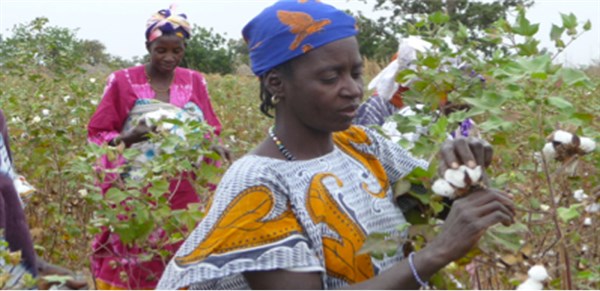
Having worked on a cotton value chain development project in Senegal myself, I was inspired to explore the effects of VC4D projects on power relations within global value chains from an academic perspective. Taking the idea that lead firms govern chains by setting rules and making decisions – for example about what to produce, how to process products, which codes and standards to follow, and which actors to include in a particular value chain, I have carried out a desk-based study to explore whether NGOs and development agencies can be considered to be taking on chain governance roles themselves through their VC4D interventions. Conceptualisations of such non-firm actors in value chain governance models (which tend to focus on lead firms) are currently lacking.
After exploring theoretical literature on value chain governance, I examined a dozen or so NGO and development agency practitioner manuals on how to carry out value chain development. Approaches vary, yet organisations typically select chains to support based on an analysis of the potential for improving the positions, and in turn livelihoods, of poor producers. Support (termed value chain facilitation) typically involves providing market information and technical training, facilitating the building of relationships between chain actors, assisting with product marketing, and advising on how to meet social and environmental standards such as organic and fair trade. Even in cases where organisations which do not advocate working within fair trade certification systems, aims tend to closely reflect many of the principles of the fair trade movement. For example, development organisations are aiming to establish higher (and fairer) prices for producers, transparency both up and down the value chain, long-term trading relationships including secure contracts, and ongoing capacity building.
Finally, I reviewed a broad range of recent empirical studies on VC4D projects throughout Asia, Latin America and sub-Saharan Africa, in order to analyse what some of the real effects of non-firm interventions in agro-commodity chains are. Firstly, I use evidence from a number of cases to argue that NGOs and development agencies are indeed becoming value chain governors. In some cases, NGOs are seen to be setting rules, monitoring and applying sanctions. They are even deciding which actors to include or exclude from a particular chain. Some become intermediaries within the value chain itself, negotiating contracts on behalf of producers, or physically handling products as they pass from producer group to processing firm. While VC4D practitioner manuals state that interventions should be temporary, and there should always be a clear exit strategy, it seems that more often than not, value chain actors are becoming dependent on the non-firm actors’ support and guidance. However, NGOs and development agencies do not always possess sufficient business expertise to be able to justify taking on such roles that go far beyond value chain facilitation.
While NGOs and development agencies are attempting to use their new-found positions in value chains to curtail lead firm power, and empower poor producers, there is little evidence that this is being achieved. NGOs are unable to significantly change power relations between small producer cooperatives and international brands, whom they rely on for good market access and sustained demand. It seems lead firms are willing to allow NGOs to gain a certain level power in value chains, as the NGOs are relieving them of some coordination tasks, and are introducing social and environmental standards which can mean access to value-added markets for retailers. Yet lead firms still maintain the right to terminate contracts and switch suppliers if their quality and speed demands are not met.
The effects of NGO and development agency VC4D interventions on chain governance are clearly varied and complex. It is also clear that practitioners would benefit from further research and reflection on best practice for VC4D projects, taking into account the effects they are having on power relations in value chains, and also taking into account the views of different value chain actors. However, while these non-firm interventions may not yet be achieving producer empowerment goals, this does not mean their actions to tackle lead firm dominance of chains are not legitimate. Indeed it can be argued that the decline in state involvement in global trade following the introduction of neoliberal policy over the past few decades has left a governance gap, which NGOs and development agencies are attempting to fill.
If global retailer power in value chains is inevitable, it may be that NGOs and development agencies move towards finding ways to co-govern value chains, alongside these lead firms. There could be potential for power in a value chain to be shared between an efficiency and profit-driven firm, and a non-firm actor striving for greater fairness in global trade.
This research is presented and discussed in more detail in the JWI Working Paper ‘The effects of non-firm actors’ interventions in agro-commodity value chains on chain governance: the case of NGOs and development agencies’.
Liz Cooper
University of Edinburgh Fair Trade Coordinator
Defining and implementing Scotland’s values for a just world
Does and should Scotland have distinct values and principles guiding its position in the world? If so, what are they, and how can they be implemented? These questions were put to speakers and delegates at a conference organised by the Network of International Development Organisations in Scotland (NIDOS) on 17th May 2013 in Edinburgh, entitled ‘Scotland 2013 and beyond: our values for a just world’.
With Scotland’s 2014 referendum imminent, organisers were keen to keep international development at the forefront of political debate – rather than allowing such issues to be drowned out by campaigns for and against Scottish independence.
Representatives from NGOs, government agencies and business each suggested key values they consider to be associated with their approaches to international development. MSP Humza Yousaf, Minister for External Affairs and International Development, spoke about a ‘socially-responsible Scotland’ and an ‘outward-facing nation’. He considers Scotland as aspiring to be a ‘good global citizen’, which doesn’t undermine aid efforts with trade and arms deals. Words that recurred throughout the day include: justice, fairness, equality, solidarity, transparency, integrity, respect and (environmental) sustainability. Positive and optimistic sentiments, but how can a nation define which values reflect those of its people? And who is to put such values into practice and how? Governments? Citizens? Civil society? The private sector?
In terms of governments incorporating such values into their practices, Peter Sörbum from NGO CONCORD Sweden explained how Sweden’s 2003 Policy for Global Development calls for a ‘whole government approach’, whereby all ministries must contribute to and not contradict international development efforts. In Scotland, ministers have recently been debating a Procurement Reform Bill. Civil society actors such as the Scottish Fair Trade Forum have been lobbying for the inclusion of a clause to embed fair trade in the concept of sustainable procurement. Here there is potential for civil society to influence government to consider particular values in policy making. The Sustainable Scotland Network plans to develop fair trade specifications for procurers of goods, so that fair trade products can easily be selected over others where available.
As for the private sector, the UK-wide approach of the Cooperative Group was presented by Hannah Newcomb, in terms of how the business is working to put into practice its stated longstanding values of fairness and equality in its global supply chains. Having been stocking fair trade products for many years, it is now aiming to go ‘Beyond Fairtrade’, by supporting smallholder farmers in numerous ways. Reflecting approaches taken by many NGOs and government international development agencies, she described how the Cooperative is working to help agricultural producers form into cooperatives, increase productivity, diversity their production, obtain loan finance, and obtain Fairtrade status. The Cooperative then provides the market for their goods through its stores.
The British Medical Association (BMA) provided another example of how the value of fairness is being considered in the medical supplies sector. The BMA is a founding member of the Medical Fair and Ethical Trade Group, which carries out research on outsourced manufacture of goods used in our healthcare sector and develops guidance for procurers of such goods. They gave examples of how migrant workers suffer poor conditions when manufacturing latex gloves for export in Malaysia, and how scalpels and other surgical instruments are made in Pakistan with no health and safety provisions, leading to many accidents and physical disabilities. Working days are often 12 hours long, there is no job security, and child labour is common. The irony in such negative impacts for health being caused by the manufacture of equipment used to protect our health here in the West was made apparent.
With Scotland having been declared a Fair Trade Nation in February this year, and conferences such as these inviting actors from different sectors to define further values for the nation beyond fairness, there are opportunities for academic research into how such values can be implemented by a nation, its citizens, its NGOs and by its firms.