Event: SCFF: Are We in the Right Process?

SCCFThe current process towards a referendum contemplates a referendum campaign and referendum on independence, which if successful would trigger negotiations on independence, and the need for a new Scottish Constitution. Referendum first, constitution-making second. It appears to be largely assumed that Scotland’s constitutional future is largely settled by the label ‘independence’, when in fact some type of new constitution would need to be designed. While the referendum process has been the subject of much debate, the question of Scotland’s post-referendum constitutional process ‘after the fact’ has been much less discussed.

Interestingly, the key difficulty with fashioning a ‘third question’ in the referendum, dealing with some half-way or hybrid between independence and the status quo, is currently alleged to be the fact that this option lacks clear or comprehensive definition. Arguably, a part of the difficulty is that any such definition would require some sort of prior substantive and inclusive process focused on fashioning a constitutional status around substantive constitutional goods and powers, rather than choosing the status first, and finding the constitutional goods and powers to fit the status.

This seminar focuses on constitutional processes, attempting to locate Scotland’s current process within models of constitutional change globally. We also use the seminar to ‘re-imagine’ a process in which form would follow substance, rather than substance being assumed to follow form. While both Scottish and UK government appear committed to the current process, this seminar asks: is there another way and what would it look like? This is not an exercise in wishful thinking. By asking the question of ‘is this the right process?’ we examine what the current independence referendum process enables in terms of constitutional change, but also what it disables.

  • Christine Bell, ‘Scotland Situated: Lesson’s from Comparative Constitutional Processes’
  • Neil Walker, ‘Would we start from here? Imagining Scotland’s Ideal Constitutional Process’

School of Law
University of Edinburgh
Lecture Room 270, Old College, South Bridge

The event is public. To register to attend please email: law.events@ed.ac.uk, with ‘SCCF Feb’ in the subject-matter line.


Posted in Events | 1 Comment

Social Justice in a new Scotland?

Dr. David Bell, University of Stirling

Prof. David Bell, University of Stirling

In the first of our series of analyses of the welfare state and the debate over Scotland’s constitutional future, Professor David Bell of the University of Stirling argues that transferring control of welfare to the Scottish Parliament would force all parties, given the tight constraints on the welfare budgets, to make difficult policy choices.

In a Scotland with powers to influence the welfare budget, there may be a collective agreement to provide more generous social welfare. But there will be some really difficult decisions to make about how to control access to benefits and what levels to set them at. There are clear demand pressures on the welfare budget that will cause it to rise as a share of GDP even at current levels of support and under most realistic assumptions on the growth rate of the Scottish economy. The challenge to all parties, irrespective of their position on constitutional change, is to explain how social justice can be delivered within a social protection budget whose growth will be more tightly constrained than at any time since the establishment of the welfare state in 1948.

The 2012 Scotland Act gives the Scottish Parliament significantly increased tax powers. But it does not change any of the powers affecting social protection – the welfare system. All of the alternatives to the Scotland Act currently on the table argue that the Scottish Government, in addition to further tax powers, should have more control over social protection spending. Devo-Plus, Devo-Max and full independence involve the Scottish Government having partial or full control over unemployment and disability benefits, state pensions etc.

But there is very little meat on the bones of these proposals thus far. There seems to be agreement in principle that enhanced powers and therefore more accountability for welfare spending in Scotland is a “good thing”, but not much clarity about the principles that might direct this development and how these might represent “Scottish values”. Further there has not been much engagement with the really challenging issues that face welfare spending in the future, which will arise irrespective of the constitutional settlement.

There are arguments that Scotland has a more social democratic tradition than England and would be likely to adopt a more generous attitude to provision of welfare benefits. There is some evidence to support this notion. Comparisons of the 2010 Scottish and British Social Attitudes surveys show that Scots take a slightly more generous attitude to welfare – they are more likely to view the current level of unemployment benefits as causing hardship and are less likely to think that large numbers of people falsely claim benefits. Nevertheless, these differences are not large: more Scots believe that benefits are too high than believe they are too low. And more Scots agree than disagree with the proposition that there are large numbers of people making false benefit claims.

When it comes to preferences about where any extra welfare spending should be directed, the Social Attitudes Survey shows that more than half of Scots agree that pensioners should be the main beneficiaries. The next most common response is the disabled; children and the unemployed are lower on the priority list. These responses pose real difficulties for politicians irrespective of the future constitutional settlement because most of the recent growth in welfare spending has been on pensioners and the disabled.

In 2010-11, the Scottish Government controlled only £4.9bn of a total social protection budget for Scotland of £20.7bn, which amounts to about 17 per cent of Scottish GDP excluding oil and 14 per cent if oil is included. Most of the Scottish Government spending, which is known as “personal social services”, is delivered by Scottish local authorities in the form of support for the frail elderly, the disabled, children, the homeless etc. But by far the largest part of the social protection budget, £15.6bn, is distributed as cash benefits by the Department for Work and Pensions. The DWP is particularly unpopular at present because of its simultaneous application of cuts and reorganisation to the benefits system. But opposition politicians at both the Scottish and UK levels have been noticeably reluctant to articulate a clearly costed alternative future for the welfare state. Instead the most vocal opposition to DWP has come from the voluntary sector and the trades unions.

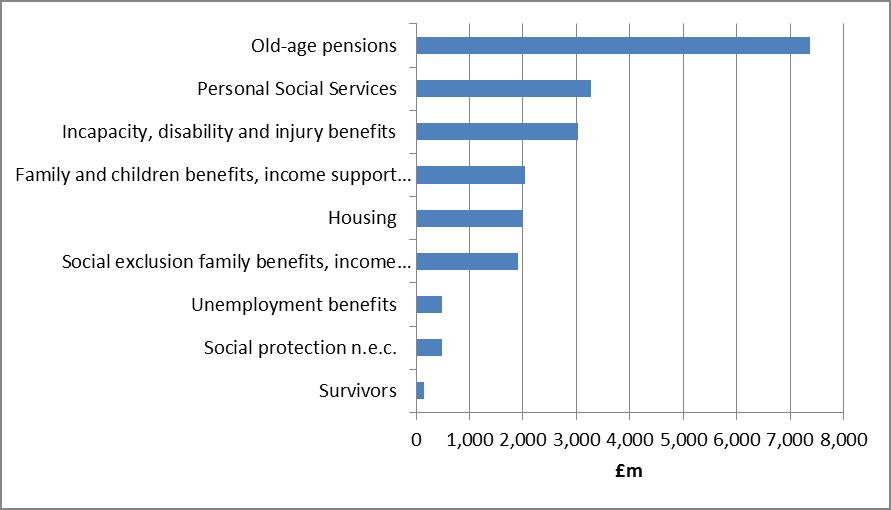
Spending per head on benefits in Scotland is greater than in the UK as a whole. In 2010-11 spending per head in Scotland was £3972 compared with £3658 for the UK as a whole, a difference of 8.6 per cent. Does this margin reflect a greater Scottish instinct for social democracy? The answer is no. DWP determines common levels of welfare support for the whole of the UK. Differences in spending per head reflect differences in demand for welfare between Scotland and the rest of the UK, not in the conditions of supply. Scotland has higher spending because it has a higher proportion of pensioners and relatively more disabled people. The majority of social welfare spending is directed towards these groups as is shown in Figure 1.

Figure 1: Social Protection Expenditure by Type Scotland 2010-11

Figure 1: Social Protection Expenditure by Type Scotland 2010-11, Source: DWP

State pensions in Scotland cost more than £7bn. Spending on personal social services tend to be directed towards the old and the disabled. Incapacity and disability benefits cost £3bn. Together these three types of spending account for two-thirds of cash benefits paid by the DWP in Scotland. Scots may agree increasing benefits to older people and to the disabled may be socially just, but there is no avoiding the conclusion that it is expensive. Increasing benefits to the unemployed would be significantly less expensive simply because they are fewer in number.

The Coalition Government has decided to “triple-lock” state pensions, implying that the amount they increase each year will be the maximum of earnings growth, prices growth or 2.5 per cent. This restores the linkage of state pensions to earnings which was lost during the 1980s and will add to their overall cost. There is further potential for cost increases as increasing numbers of baby-boomers pass retirement age. The Coalition Government has moderated this growth, at least in the short-run by increasing the retirement age, a policy that is arguably not fair in parts of Scotland where life expectancy is particularly short. The number of disabled may increase depending on the future incidence of diseases such as obesity and dementia.

In a Scotland with powers to influence the welfare budget, there may be a collective agreement to provide more generous social welfare. But there will be some really difficult decisions to make about how to control access to benefits and what levels to set them at. There are clear demand pressures on the welfare budget that will cause it to rise as a share of GDP even at current levels of support and under most realistic assumptions on the growth rate of the Scottish economy. The challenge to all parties, irrespective of their position on constitutional change, is to explain how social justice can be delivered within a social protection budget whose growth will be more tightly constrained than at any time since the establishment of the welfare state in 1948.

David Bell is Professor of Economics and ESRC Senior Research Fellow on the Future of Scotland and the UK, University of Stirling. This article was also published in the Scotsman on 19 February, and is derived from a paper presented to the David Hume Institute/Academy of Government seminar ‘Delivering Social Security: Options in Scotland’s Constitutional Debate.’ A full version of the paper is available at: http://www.davidhumeinstitute.com/research.html

Posted in Welfare and Social Policy | Leave a comment

Event: Thinking Together: A Citizens Assembly

Join us in ‘Thinking Together’: A Citizens Assembly

The Public Policy Network / Academy of Government is one of the founding members and supporting collaborators of So Say Scotland, a non-partisan, non-profit, voluntary network of dream-makers working to turn Scotland into a hub of democratic innovation.

So Say Scotland is chuffed to announce that we are hosting our first Thinking Together Citizens Visioning Assembly on February 28th 10-5pm, Lomond Auditorium at the SECC, as part of the SCVO Gathering.

We are gathering together a diverse mix of folk from across Scotland to spend a day in facilitated dialogue. Thinking together, in a new way, and discussing values for the Future of Scotland.

We have 192 participant seats to fill… and need every type of voice to make it count!!

Thinking Folk can register their interest in participating on The Gathering website or on 0131 220 0246.

Posted in Events | Leave a comment

Event: Delivering Social Security: Options in Scotland’s Constitutional Debate

DebatingChamberMonday 18 February 2013
6:00pm
The Royal Society of Edinburgh

How we guarantee welfare through social security and other measures is one of the most disputed issues in Scottish and UK politics. The UK Coalition Government’s welfare reforms are controversial: seen by many as a necessary response to economic crisis, they are seen by many others – not least in Scotland – as a rejection of long-cherished values.

The controversies around welfare policy have long helped to animate Scotland’s constitutional debate. For some devolution was a necessary protection of Scotland against unpopular policies devised south of the border. For others it has helped to embed a ‘something for nothing’ culture. This David Hume Institute seminar takes place against this background of sharp political differences over how best to secure welfare in Scotland. Specially commissioned papers will set out the economic context – what the fiscal challenges in covering existing commitments will be, and what opportunities for (and obstacles to) change there are. Others will explore the scope to fine-tune the devolution settlement to deliver distinctive policies for Scotland, drawing on examples from Belgium and Northern Ireland to show what is and is not possible. Others still will explore the possibility that independence might offer an opportunity better to reflect Scottish values in welfare policy – but also the continuing interdependencies with the rest of the UK that would exist and could limit such opportunity.

Speakers include:

  • Professor James Mitchell, University of Strathclyde Chair
  • Professor Charlie Jeffery, University of Edinburgh (Supported by ESRC)
  • Professor David Bell, University of Stirling
  • Professor Bea Cantillon, University of Antwerp
  • Professor Derek Birrell, University of Ulster
  • Dr Nicola McEwen, University of Edinburgh
  • Jeremy Purvis of the Devo-Plus Group

This seminar is run in collaboration with the Academy of Government at the University of Edinburgh. Registration is free for members of the David Hume Institute and £25 for non-members and £10 for students. Register for the seminar.

Posted in Events, Welfare and Social Policy | Leave a comment

A Scottish Defence Model – Learning from others

Colin Fleming, University of Edinburgh

Colin Fleming, University of Edinburgh

Dr. Colin Fleming reflects on the security and defence obligations of an independent Scotland, looking particularly at the implications of the Nordic models of defence and continued integration with the defence structures of the rest of the United Kingdom. 

If Scotland votes yes in 2014 there is little doubt that it will enter a relatively benign security environment. The problem for Scotland, like other independent states, would be how to plan for the unexpected. The requirement to begin defence policy discussions with a clear understanding of what threats Scotland may face is also highlighted in a recent RUSI Whitehall Report, A’ The Blue Bonnets: Defending an Independent Scotland. As the authors, Stuart Crawford and Richard Marsh, comment:

The immediate requirement is to attempt to define the strategic context in which Scotland finds itself, and also identify what are the likely risks and threats to the soon-to-be-independent state…. Despite being relatively small and sparsely populated, Scotland’s geopolitical position bestows upon it a certain geostrategic importance.

It is this geostrategic area of importance which has drawn the SNP to look to its Nordic neighbours as having legitimate defence models which Scotland could adapt to its own national interests.

Norway and Denmark are of particular interest, and have helped shape current SNP thinking on defence issues. Both have close similarities with Scotland in terms of population size, and both have national interests in oil and gas, fishing, and the emergence of the High North as an area of geo-strategic interest – as a maritime state these are areas that a Scottish Defence Force would be required to secure. As is being proposed currently, it would also be required to integrate its maritime assets with partners, particularly focusing on the security of the North Atlantic and High North. These are tasks which would also require air-policing assets. Of course, on a purely political level, Norway and Denmark provide unequivocal proof that similar sized countries make an important contribution in the maintenance of regional and international security; a fact not lost on the SNP leadership. Claims that Scotland is too small or too weak to build a meaningful military defence model with a regional – or even international – focus seem specious when juxtaposed against recent Norwegian and Danish experiences in Afghanistan.

Although the official blueprint of Scotland’s defence policy post-independence will be published in the Scottish Government’s White Paper in November 2013, the SNP has been talking to academics, policy-makers, and military personnel from Denmark, Norway and Sweden, and it is probable that Scotland’s operational capabilities would resemble a Nordic design, allowing it to become a key partner in the region. Of course, Scotland’s future military capabilities would initially be linked to its negotiations with the RUK government, but it would look to provide an operational capability able to position itself as a regional partner with its Nordic neighbours, as it would the RUK.

The Nordic countries have also had a very real effect on how the SNP sees a Scottish force operating in regional and international theatres and have helped shape an internationalist underpinning to a potential future Scottish defence structure. The party’s reversal of its opposition to NATO (but not nuclear weapons) was based on research and discussion with Nordic defence establishments; and in the event of independence, its strategic partners. The decision to change such an important policy is specifically linked to how the SNP envisages Scotland’s role as a regional actor and the importance Norway and Denmark attach to NATO membership. This change in policy is important for several interrelated reasons. It highlights a new pragmatism within the SNP in terms of its international outlook; however, perhaps more crucially, it also underlines the party’s commitment to cooperation and the integrating of defence with other independent states – not least, RUK.

The SNP has consistently highlighted its desire for Scotland to continue strong defence relationships with RUK, and has expressed a keen interest in defence sharing – particularly in intelligence, basing, and training. The idea of defence-sharing is not without criticism. For many, an independent military is equivalent to independence itself. However, and yet again, the influence of the Nordic States, in the form of Nordic Defence Cooperation (NORDEFCO), is plain for all to see. Norway, Denmark, Sweden, Finland, and Iceland, have had defence sharing agreements since 2009 and in the event of independence it is something which may prove attractive to both Scotland and RUK. In fact, defence-sharing looks likely to be normalised over the coming years and decades, driven in part by increased austerity and the requirement to drive down defence budgets. Defence sharing is already partly developed in the Baltic States, and only in November 2012 the Australian Minister of Defence met with New Zealand Minister of Defence to identify further practical military cooperation. NATO, the world’s most successful military alliance is now openly talking about ‘Smart Defence’ (defence sharing) among its members, as a means of allowing the alliance to continue its core roles with the most advanced kit. This requires defence cooperation amongst all of its members.

Defence-sharing between Scotland and RUK is workable, and in light of international austerity measures and the impact of ongoing cuts to the UK’s defence budgets, may also be pragmatic in the long-term. However, for such agreements to take place both governments would have to negotiate mature policy arrangements; with trade-offs and benefits for both states. Under this scenario, an independent Scotland would not require full-spectrum capabilities, but it would still require compromise and negotiation in order to gain the right mix of maritime, air and land assets able to perform roles similar to those of Norway and Denmark. For Scotland, one such trade-off may be that Trident stays on the Clyde for longer than voters expect.

Dr Colin Fleming is an Honorary Research Fellow in Politics & International Relations at the University of Edinburgh. Dr. Fleming published an extended version of this piece in Holyrood Magazine on 28 January 2013. 

Posted in Defence and Security | Leave a comment

Event: Showcasing the Scottish Social Attitudes Survey

Evening Saltire

Evening Saltire

Showcasing the Scottish Social Attitudes Survey – Exploring attitudes towards Scottish independence using repeated cross-sectional surveys
18 March 2013 – 9:15am – 12:30pm
Bute Room, National Museum of Scotland, Chambers Street, Edinburgh
hosted by AQMeN and ScotCen

Speakers:

  • Professor John Curtice – ScotCen Social Research, University of Strathclyde
  • Rachel Ormston – ScotCen Social Research, Director Scottish Social Attitudes Survey
  • Professor Lindsay Paterson – AQMeN, University of Edinburgh
  • Dr. Jan Eichhorn – AQMeN, University of Edinburgh

>> View the programme
>> Register to attend

Posted in Events | Leave a comment

Event: Gender Equality Matters in a New Scotland

Women and Constitutional Futures Seminar Series:
Gender Equality Matters in a New Scotland
SEMINAR 3: 14-15 February 2013.
Royal Society of Edinburgh, 22-26 George Street, Edinburgh

        • Why should women care about constitutional debates?
        • Where are women’s voices and gender equality issues in the current discussions?
        • What do different constitutional options mean for women’s lives and the likely progress towards a more gender equal society?
        • Does focusing on constitutional remedies deflect attention from pressing issues?
        • What sort of Scotland do women want? Join the debate!

We draw upon international experience and lessons learned to date in Scotland and the UK to address these important issues.

Confirmed Speakers include:

  • Thor Gylfason, Chair of Icelandic Alliance for a New Constitution
  • Georgina Waylen, University of Manchester, international expert on gender and constitutional reform
  • Alan Miller, Chair Scottish Human Rights Commission
  • Alice Brown, Former member Consultative Steering Group on the Scottish Parliament
  • Tania Verge, Universitat Pompeu Fabre, Barcelona. Expert on women and politics in Cataluyna and Spain
  • Dave Moxham, Deputy Secretary General STUC
  • Niki Kandirikira, Director of Scottish women’s organisation, Engender
  • Christine Bell, University of Edinburgh, feminist legal and constitutional scholar,
  • Bob Black, Former Auditor General, Scotland

Chaired by Lesley Riddoch.

To register and learn more, please click here.

Posted in Events | Leave a comment

Podcast: The Scottish Referendum

The Scottish ParliamentDr Nicola McEwen, director of public policy at the Academy of Government, Dr Simon Clark, head of the School of Economics, Professor Stephen Tierney, director of the Edinburgh Centre for Constitutional Law, and Professor Ewen Cameron, the Sir William Fraser chair of Scottish History have taken part in The Big Idea Podcast, the University’s new monthly audio series. The experts discussed issues surrounding next year’s referendum on Scottish independence.

Download from iTunes U.

Posted in General | Leave a comment

Our Friends in the North East

Richard Parry, University of Edinburgh

Richard Parry, University of Edinburgh

Richard Parry, a Reader in Social Policy at the University of Edinburgh highlights an English dimension in the current debate. He notes that local leaders in the North East fear competition from Scotland, either devolved or independent, and may come to regret their rejection of a regional assembly in light of increasing marginalisation. 

It can be painful living in area with weak local political institutions next to one with a powerful political system able to take decisions about its own destiny. This is where the North East of England feels itself to be at the moment, and the issue provoked lively discussion at a roundtable in Edinburgh on 29 January, part of a project by researchers from Northumbria and Durham universities and IPPR North, and funded by the Association of North East Councils. It follows IPPR North’s report Borderland: Assessing the Implications of a more Autonomous Scotland for the North of England, published in November 2012  (IPPR also published on 25 January Alan Trench’s impressively clear and detailed report Funding Devo More: Fiscal Options for Strengthening the Union).

The North East’s decision in 2004 by a vast 78-22 margin to reject the offer of an elected regional assembly with limited powers now seems like a bad move. Voting no was presented as a way to preserve the two-tier local government system in the region, but this has now gone anyway in favour of unitary authorities. The Regional Development Agency has been abolished by the coalition UK government in favour of weaker ‘Local Economic Partnerships’ (Lecs) that avoid any regional political identity. Senior local authority officials at the roundtable conveyed a real sense of anger at the London-centric approach they now face, with Manchester and Leeds bought off as prospering big cities.

Even without independence, Scotland’s political and economic power is envied and feared in the region. First Minster Alex Salmond offered friendship and turned in a typically impressive performance when speaking in Newcastle on 13 November 2012, but left no-one with the illusion that his government would relate on equal terms to the North East’s collection of local authorities and ah hoc co-ordination mechanisms. Suggestions of Scottish reductions in Corporation Tax and Air Passenger Duty fuel fears of the North East being sucked dry of inward investment and communications links by a more powerful Scotland.

Before devolution, Scotland and the North East seemed in many ways comparable, both ‘regions’ in the UK, subject to similar economic policies to address similar economic problems. Scotland had an extra level of history and identity but the North East too was cohesive, proud and solidaristic. Now the North East has to make its way as a peripheral area of England, marginalised and lacking influence at the centre. Scottish independence might afford the North East specific recognition as a border region vulnerable to economic competition from Scotland. But for the present the North East is watching anxiously the protracted constitutional debate to its north.

Richard Parry is Reader in Social Policy in the School of Social and Political Science, University of Edinburgh.

Posted in Constitution | 1 Comment

A Question of Fairness?

Dr. Nicola McEwen, Academy of Government

Dr. Nicola McEwen, Academy of Government

Dr Nicola McEwen, Director of Public Policy at the Academy of Government, provides an assessment of the Electoral Commission’s recommendations on the Scottish independence question. She argues that in spite of the speedy acceptance of the Commission’s key recommendations, the details of their report pose challenges for both the Scottish and UK Governments.

But it is beyond even the Electoral Commission to devise a question that satisfies its criterion of being unambiguous. Simply asking if Scotland should be an independent country leaves open the question of what being an independent country would actually entail.

The publication of the Electoral Commission’s report into the referendum question (.pdf) marks another milestone on the long road to Scotland’s independence referendum. We now know the question Scots will be asked in autumn 2014: ‘Should Scotland be an independent country? Yes/No’

This is a modification of the original question, but the new formulation was immediately accepted by the Scottish Government, and both the Yes and No campaigns. It is ultimately a matter for the Scottish Parliament to decide whether it will pass the government’s referendum bill once tabled, but the SNP majority and the emerging consensus on the question wording and other process issues should make for a smooth legislative ride.

In testing the question, the Electoral Commission was following rules set out in the Political Parties, Referendums and Elections Act 2000 (PPERA). The main criterion in PPERA relates to a question’s ‘intelligibility’. This is interpreted broadly to mean that the question should be succinct, neutral, easy to understand and unambiguous. In the context of a pre-legislative independence referendum, it is not possible to satisfy all of these criteria.

Both the original and revised questions are succinct, being considerably shorter and more to the point than the more convoluted questions of previous constitutional referendums, for example, in Wales and Quebec. The question in both formulations was also deemed easy to understand. Compared to previous referendums, the Commission reported unusually ‘high and consistent levels of understanding’ among the research participants about what they were being asked, and most were able to vote according to their preferences. This was put down to familiarity with the independence issue in political debate over many years, and its current prominence on the political and media agenda.

The original question fell short only on the grounds of neutrality. Some participants in their research felt that the original ‘Do you agree…’ formulation could lead voters towards a positive answer and made it more difficult to say ‘no’. Asking a ‘Should…’ question was deemed more impartial. These findings strongly echo the Commission’s research and recommendations relating to previous referendum questions in Wales, the North East and in the UK-wide Alternative Vote referendum. It is essential that the referendum is seen to be fair, with a neutral question, and I welcome the Commission’s revision.

But it is beyond even the Electoral Commission to devise a question that satisfies its criterion of being unambiguous. Simply asking if Scotland should be an independent country leaves open the question of what being an independent country would actually entail.

Inevitably, there will be competing visions of what independence would mean for Scotland within the context of the debate, and no-one can say for sure what the outcome of independence negotiations would be. This lack of clarity may make it more difficult to secure majority support, but a YES vote in this context would carry considerable legitimacy. The question, as posed, is effectively asking voters whether Scotland should be in independent country come what may.

The Commission’s report poses challenges to both advocates and opponents of independence.

The Scottish Government spent much of last year emphasising the continued associations that Scotland and the rest of the UK would share after independence. Independence would not cut Scotland off from its neighbours, but would mark a new relationship with the rest of the UK. A partnership of equals, in which we continued to share a social union, a monarchy, a currency union, a labour market, an energy market, a common travel area, and a variety of other possible institutions and services. Independence was even deemed compatible with continuing to feel British. One could be forgiven for questioning what would be different under this vision of independence. And yet, the Electoral Commission’s report indicated that its research participants – and the Commission itself – still regard independence and separation as one and the same. As the report notes:

While people initially articulated their understanding in different ways, it was clear from further discussion in the interviews and groups that, with one or two exceptions, participants had a clear understanding – without seeing or asking for any explanatory information – that ‘independent country’ referred to Scotland being separate from the rest of the UK. (Para 3.40)

Perhaps most of all, the Commission’s research revealed a hunger for greater information and clarity on what independence would mean in practice, and the process by which it would be achieved. Providing clarity on these issues is not within the gift of the Scottish Government. It can set forth its vision of independence, but almost everything will be subject to negotiation with the UK government, the European Union, NATO and a range of other stakeholders. The oft-repeated mantra of UK government ministers is that there will be ‘no pre-negotiation’ before the referendum. This is clearly politically pragmatic but, by extension, it means that clarity on the meaning of independence will be hard to come by.

The Electoral Commission has called on both governments to clarify the process that will follow the referendum ‘in sufficient detail to inform people what will happen if most voters vote “Yes” and what will happen if most voters vote “No”’. This passage from the report indicates how difficult it may be to separate process from substance. The recommendation potentially pushes the UK government toward uncomfortable terrain. Having insisted that the Scottish Government follow the Commission’s advice, it will be difficult for UK ministers to now ignore it.

Posted in Referendum process, campaign and vote | 2 Comments