After the Referendum

Dr Steven Tierney, University  of Edinburgh

Prof Stephen Tierney, University of Edinburgh

In a piece originally published at the UK Constitutional Law Blog, Professor Stephen Tierney turns his attention to the process which might ensue following a yes vote, looking to the paper published by the Scottish Government on independence and the constitution. Stephen  argues that the debate generated by this publication will have important implications whether or not the referendum succeeds.

The debate over Scottish independence has turned recently to discussion of the post-referendum landscape. On 5 February the Scottish Government published Scotland’s Future: from the Referendum to Independence and a Written Constitution  which suggests that a two stage process would follow upon a majority Yes vote. From the date of the referendum until March 2016 a period of constitutional negotiations with the UK Government is proposed, culminating in the formal grant of independence by Westminster. Following the Scottish parliamentary elections in May 2016 a constitution-framing process, internal to Scotland only, would then take place. Although the prospect of a Yes vote is, to say the least, far from certain with support failing to rise above 35% in most polls, each of these proposed stages is interesting, not least for the questions left unanswered in the Scotland’s Future paper.

It is likely that these issues will be discussed in detail over the next 18 months. Regardless of the outcome of the referendum they may well also prompt wider UK debates about constitutional change and could also help frame the landscape for further constitutional re-thinking in Scotland, even in the event of a majority No vote.

The first issue is timing. Scotland’s Future (1.6) states: ‘The right time for a written constitution to be drafted is… after independence, not before. At that point the people of Scotland, whatever their views in the referendum, will be able to engage fully in the process of planning for our country’s future.’ It is, therefore, not the intention of the Scottish Government to engage in setting out a draft constitution in advance of the referendum. But it still seems inevitable that speculation about the content of a future constitution of an independent Scotland will inevitably be a focal-point, albeit possibly not a major one, of the referendum campaign, particularly after the Scottish Government publishes its promised White Paper towards the end of this year on the content of independence which will inevitably contain commitments which would in due course require constitutional protection.

Not surprisingly, therefore, Scotland’s Future is somewhat light on the possible content of a new constitution, but there are some hints about the Government’s preferences. It is notable in itself that the Government proposes a written constitution (Scotland’s Future 1.5). It also suggests that the Sovereign will continue as head of state (2.14); that there will be a Supreme Court of Scotland, and that this court will have the power to strike down unconstitutional legislation (the constitution will contain ‘citizens rights that cannot be taken away by a decision of Parliament’ – 1.5). This raises a number of questions about court structure under the new regime. How would a new Supreme Court be established and how would it be populated? Would it be a free-standing court with personnel separate from the existing superior courts in Scotland, and if so could this be justified given the limited number of constitutional issues that come from Scotland to the UK Supreme Court at the moment? Or would judges from the Court of Session sit on this on an ad hoc basis? 

There is also a reference to Scotland’s membership of the European Union (and of course there is a separate debate about how that membership will be secured) being subject to constitutional provision (2.3). Little is said about institutional arrangements. One question that will inevitably arise in the referendum campaign is whether there would be any proposals to make the Scottish Parliament bicameral or at least to institute some model of review body to assess and scrutinise draft legislation.

Scotland’s Future spends longer setting out a commitment to collectivist values in the form of social rights which it suggests will also enjoy constitutional protection. There is a proposal to enshrine within the constitution an entitlement to public services and ‘to a standard of living that, as a minimum, secures dignity and self-respect’ (1.10) and possibly also ‘constitutional rights in relation to issues such as welfare, pensions, health care and education’ (1.10). There is also a radical suggestion that principles on climate change, the environment and the sustainable use of Scotland’s natural resources should be constitutionally protected and that there might be a constitutional ban on nuclear weapons being based in Scotland. Each of these proposals of course raises questions about what type of enforcement would accompany such provisions; in particular would the courts be vested with the duty to enforce social and environmental rights etc., the constitutional appropriateness of such a duty the competence of judges to execute it. The final substantive proposal inScotland’s Future is for an examination of the war power and a constitutional guarantee that this power would be shared by the Scottish Government and the Scottish Parliament. Separately, the Government has also suggestedconstitutional provisions on Scotland’s system of local government.

The paper also turns to process and it is here that the two stage approach emerges. The first stage after the referendum would be the interim period within which Scotland would become independent. The intention is that during this period of some 15-16 months up to March 2016, agreements will be reached between the Scottish and UK Governments on this transition, establishing the timetable towards ‘independence day’ in March 2016. All of this would pave the way for the scheduled elections to the Scottish Parliament in May that year, which would on this proposal become elections to the Parliament of an independent country.

Scotland’s Future acknowledges that the following issues would need to be the subject of  negotiation and agreement: ‘the division of financial and other assets and liabilities (including oil revenues and assignation of other tax revenues, military bases and overseas assets), the transfer to the Scottish Parliament and Government of political authority over institutions previously controlled at Westminster… and the timetable for the speediest safe removal of weapons of mass destruction from Scotland.’ Interestingly, there is also reference to the ‘on-going co-operative arrangements that the peoples of Scotland, England, Wales and Northern Ireland would share’. It is not clear what is meant by this, although notably the Scottish Government during its period in office between 2007 and 2011 produced a White Paper ‘Scotland’s Future: Draft Referendum (Scotland) Bill Consultation Paper’  which famously stated that under independence ‘the social union with the remainder of the UK would be maintained, with the nations continuing to co-operate on a range of matters’. It is not clear if this is what is meant by ‘on-going co-operative arrangements’ in Scotland’s Future. It is also acknowledged in Scotland’s Future that some matters will remain unresolved until after independence as happened in the split between the Czech Republic and Slovakia; in other words even after 2016 there would still be an on-going period of gradual separation.

Turning to process, it is also suggested that the Scottish Government will seek to make the post-referendum negotiations inclusive (2.7) by inviting ‘representatives from the other parties in the Scottish Parliament, together with representatives of Scottish civic society’ to join in these negotiations and in helping to ensure ‘the continuity of those public services which are in reserved areas.’ The basis for the interim arrangements would be a ‘constitutional platform’ to facilitate the new Parliament and Government elected in 2016. There would potentially be something of a constitutional vacuum after ‘independence day’ when the writ of the Scotland Act would no longer run but in which no new constitution would have yet been promulgated. And so (2.10) ‘until that constitution is drafted and comes into force, arrangements will be in place from independence day to consolidate the existing rights of citizens and give the Scottish Parliament and Government the legal, financial and other powers necessary to govern Scotland effectively across the full range of national issues. These arrangements will form Scotland’s constitutional platform.’ A number of questions arise: where would sovereignty rest in this period – would the Scottish Parliament take on a new sovereign power through the constitutional platform, or would there be some notional reversion to the sovereignty of the pre-1707 Scottish Parliament? And what of the Crown, the Privy Council etc.? Finally, Scotland’s Future proposes a constitutional path to terminate Westminster’s authority. The UK Parliament would legislate ‘to acknowledge the end of its power to legislate for Scotland’ (2.13) in a way similar to the Malta Independence Act 1964 and the 1931 Statute of Westminster.

There is also some discussion of the process towards a written constitution.Scotland’s Future suggests the possibility of a constitutional convention to be convened by the newly elected independent Scottish Parliament to draft this (1.7). It is not clear what shape this would take but it ‘should engage all the people of Scotland in the process of nation-building and allow them a say in defining how our country will work. (1.6)’ Reference is made to the citizen-led assemblies and constitutional conventions convened in British Columbia (2004), the Netherlands (2006), Ontario (2007) and Iceland (2010) as well as the citizen-led constitutional convention convened in Ireland in 2012. Given that such an open process is proposed we must assume that the substantive proposals for the written constitution set out in Scotland’s Future would themselves be open to revision. For example, such a constitutional convention may well decide not to include social rights and could also opt for a republican rather than monarchical system of government etc. Finally, another question is, would there be referendum to ratify this constitution and would the referendum find its way into the constitution as a standard mechanism of constitutional amendment? What we know of referendum use is that it tends to be contagious; once used to change a system of government it often finds its way into a new constitution as part of the process of future change.

What we know of referendum use is that it tends to be contagious; once used to change a system of government it often finds its way into a new constitution as part of the process of future change.

It is likely that these issues will be discussed in detail over the next 18 months. Regardless of the outcome of the referendum they may well also prompt wider UK debates about constitutional change and could also help frame the landscape for further constitutional re-thinking in Scotland, even in the event of a majority No vote.

Stephen Tierney is Director, Edinburgh Centre for Constitutional Law. This blog is based upon a paper given to the Law Society of Scotland on 7 March 2013. I am grateful to those present for a most fruitful discussion of the paper.

Suggested citation: Stephen Tierney, ‘After the referendum – the Scottish Government’s proposal for a written Constitution’ ,  UK Const. L. Blog (12 March 2013) (available at http://ukconstitutionallaw.org).

Posted in Constitution, Referendum process, campaign and vote | Leave a comment

The Plebiscite on Puerto Rico’s Constitutional Status: Determining Puerto Rico’s Future

Dr Jaime Lluch, University of Pennsylva

Dr Jaime Lluch, University of Pennsylva

The University of Pennsylvania’s Jaime Lluch discusses Puerto Rico’s plebiscite on the territory’s constitutional status, pointing to the ambiguity inherent in the relationship between Puerto Rico and the United States. 

Last November 6, the citizens of Puerto Rico held a plebiscite on their future constitutional status. This is the fourth plebiscite of this sort that has been held in Puerto Rico, following those held in 1967, 1993 and 1998.

Both the procedural pathway that led to the holding of the plebiscite and the substantive results emerging from it may be of interest to those who are concerned with the process leading to the 2014 Scottish referendum on independence.

Background: The territorial autonomy of Puerto Rico
Since 1898, Puerto Rico has been an “unincorporated territory” of the United States, and the nature of its relationship with the U.S. has been set by federal statutes, especially the Foraker Act of 1900, the Jones Act of 1917, and the Federal Relations Act of 1950-1952. Although the US Constitution provides for “states” and “territories,” the category of “unincorporated territory” was sculpted by the U.S. Supreme Court. Puerto Rico has a very peculiar form of territorial autonomy. It has a special status arrangement within the United Sates. It is part of the wider US federal political system, but it is not one of the constituent units of the US federation. Its autonomy is called “Estado Libre Asociado” (ELA), or free associated state, but it is neither free nor associated nor a state. There are now less than 4 million people on the Island and another 4 million plus Puerto Ricans on the US mainland, many of which circulate back and forth. Puerto Ricans are US citizens by virtue of the 1917 federal statute, but they cannot vote in US federal elections.

For well over a century, politics in Puerto Rico has not been about political economy or the relation between the state and society. Instead, it has mainly been a debate about how the territory will relate to the central US state and about how different conceptions of national identity shape this debate.

Autonomies such as Puerto Rico are non-federalist because they are constitutionally subordinate to the center. The “shared rule” component between the central state and the autonomous unit is weak or practically non-existent. The power to terminate or modify the Puerto Rico-USA relationship rests squarely within the US Congress. During 1952-53 the US succeeded in getting Puerto Rico off the agenda of the UN Decolonization Committee in part by arguing that the Estado Libre Asociado was a compact of a bilateral nature whose terms may only be changed by common consent. However, soon thereafter Congress and the Executive branch started to behave “as if no compact of any kind existed and as if Puerto Rico continued to be a territory or possession of the United States, completely subject to its sovereign will. Puerto Rico leaders would spend the rest of the century unsuccessfully trying to convince the United States to allow full decolonization” (Trías Monge 1997). Supporters of the ELA have tried on several occasions to negotiate a “culminated ELA,” starting with the Fernós-Murray bill of 1959, but they have been unable to obtain the consent of the US Congress. However, Congress continues to assume that it can unilaterally exercise plenary powers over Puerto Rico under the territorial clause of the US Constitution, and the US government contends that sovereignty over Puerto Rico resides solely in the United States and not in the people of Puerto Rico.

For well over a century, politics in Puerto Rico has not been about political economy or the relation between the state and society. Instead, it has mainly been a debate about how the territory will relate to the central US state and about how different conceptions of national identity shape this debate. These debates are dominated by three well-defined political orientations in the political party system: independentist, autonomist, and federalist (“let’s become a unit of the federation”).

Previous Plebiscites of 1967, 1993, and 1998
In all the previous plebiscites, the choice offered to the electorate has been to decide between independence, autonomy or federalism. In 1967, autonomism won with 60% of the vote, while the independentists boycotted the event. In 1993, 48.6% voted for autonomism, 46.3% for federalism, and the rest for independence. In 1998, 50.5% voted for “none of the above,” 46.6% for federalism, 2.6% for independence, and 0.3 for free association.

The plebiscite of November 6, 2012
Some years ago the independentist party offered a proposal for holding a plebiscite with two rounds. In the first round, the people would be asked whether they wanted to continue living under the present (colonial) “unincorporated territory.” If the answer chosen by a simple majority was “No,” then there would be a second round (months later) in which the people would be asked to choose among the three non-territorial options, following an educational campaign. The idea was to narrow down the options to the ones that would decolonize the polity. This was seen as a mechanism for finally decolonizing the Island, given that the USA Congress had never shown an interest in doing so, or in even holding a federally-sponsored plebiscite in Puerto Rico.

Last year, the federalist party in power in Puerto Rico adapted the idea of a two-step referendum and proposed instead a two question referendum, to be held on the same day as the regular elections for selecting both the new Governor and the new legislature (with a view to boosting their support in the regular elections).

Thus, in the plebiscite of 6 November 2012, the people were asked two questions. The first was: “Do you agree that Puerto Rico should continue to have its present form of territorial status?” In the second question, they were asked to choose between federalism, independence, and a “sovereign ELA”, which is a light version of a genuine status of free association. The autonomist party actively and energetically campaigned for a Yes vote on the first question, and on the second question a “blank vote.” The results showed that 54% of the people voted No in the first question – a No vote in this context suggesting a vote for change. For the first time in their history, Puerto Ricans voted to show their disapproval of their present political status. This is the most important result of this event.

Among the choices offered by the second question, federalism received 61%, sovereign ELA 33.3%, and independence 5.5%, but there were 480,918 blank votes, so if those votes were to be counted, federalism received only 46% of the vote.

The US Congress, as the political branch of the central state, needs to take up its responsibility to de-territorialize Puerto Rico. In light of these results, another vote should be taken among these three options, but this time in a Congressionally-sponsored plebiscite.

The U.S. Congress has never agreed to provide for a binding referendum. This is not just a matter of respecting and implementing the result of the vote, but of exercising its responsibility as the dominant power.

Every single one of the four plebiscites that has been held in Puerto Rico has been a locally-sponsored one. The U.S. Congress has never agreed to provide for a binding referendum. This is not just a matter of respecting and implementing the result of the vote, but of exercising its responsibility as the dominant power. Moreover, only the US Congress can define what sort of conditions would be imposed if the people want to join the federation, what kind of transition period there would be were independence to be chosen, or what sort of expansive model of autonomy the U.S. Congress would be willing to grant Puerto Ricans.

Dr. Jaime Lluch is the Visiting Fellow in Democracy, Citizenship, and Constitutionalism at the Political Science Department, University of Pennsylvania. He is available at      jaime.lluch@gmail.com

For more information on autonomism in Puerto Rico, please read:

Jaime Lluch, “Autonomism and Federalism,” in Publius: The Journal of Federalism, Vol. 42 (1) Winter 2012.    

Jaime Lluch, “Sovereigntists and Associationists: Explaining the Origins of National Movements’ Political Orientation,” in Nationalism and Ethnic Politics, Vol. 17, No. 2 (April, 2011). 

Posted in Overseas Perspectives | Leave a comment

The Costs of State Pensions in Scotland

Dr. David Bell, University of Stirling

Dr. David Bell, University of Stirling

This post by the University of Stirling’s Dr. David Bell looks at the future costs of State Pensions in Scotland. Dr. Bell argues that given today’s revelations about the Scottish Government’s leaked paper, this is perhaps a useful time to look at some of the facts. This was originally posted at Dr. Bell’s The Scottish Economy and Constitutional Change blog.

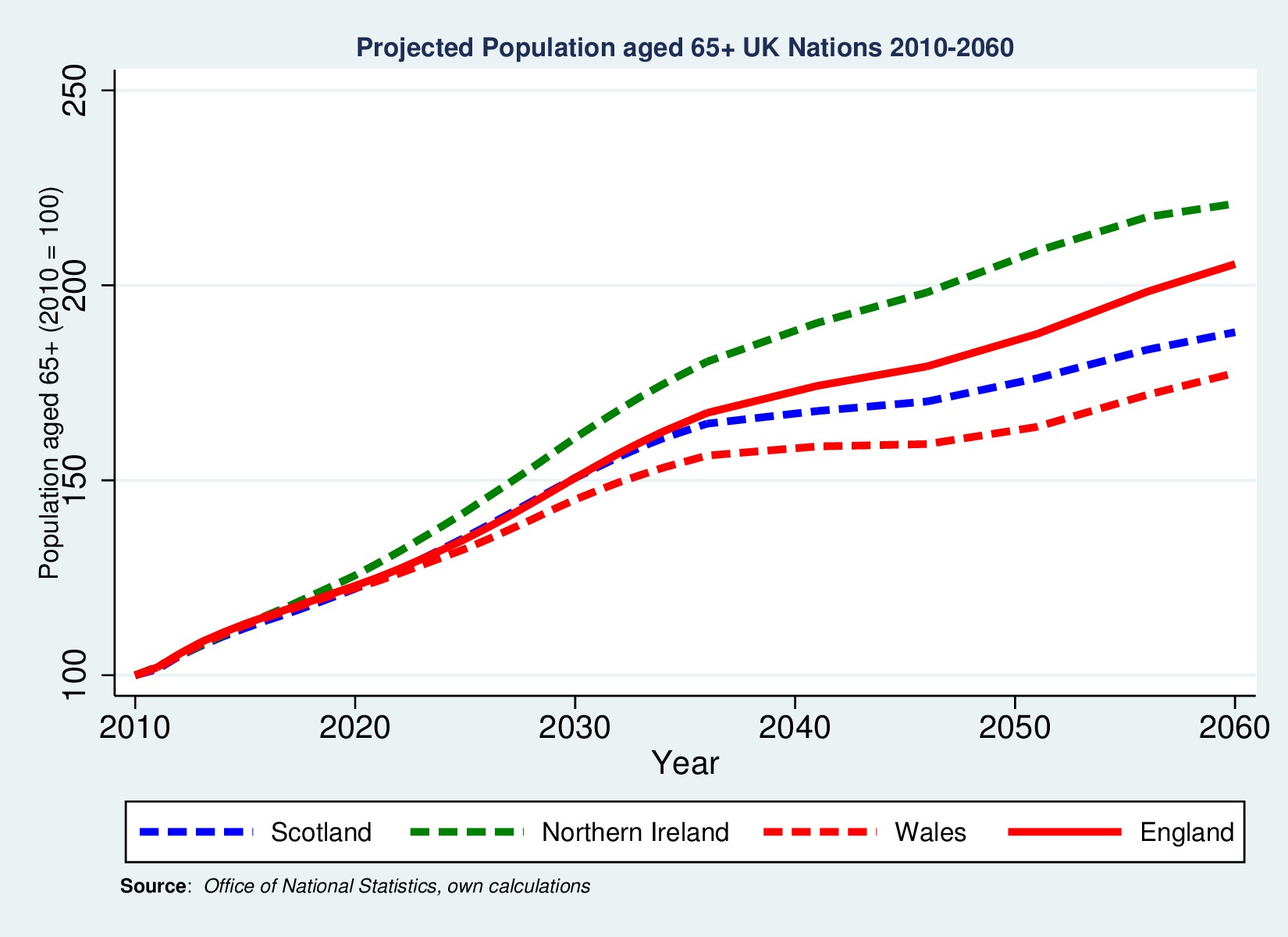
The figure below shows projected numbers of pensioners in the constituent countries of the UK looking forward to 2060 indexed on 2010=100  (Source: ONS). Growth in pensioner numbers is slower in Scotland than in England, partly reflecting an assumption that Scots will continue to have lower life expectancy.  Nevertheless, the number of Scots pensioners will increase by 80 per cent between 2010 and 2060, with most of the increase concentrated in the 2010-2035 period.

Figure: Indexed Number of Pensioners: Scotland, England, Wales and Northern Ireland 2010-2060

Figure: Indexed Number of Pensioners: Scotland, England, Wales and Northern Ireland 2010-2060

If Scotland acquires new fiscal responsibilities, including control over welfare benefits, there will be a need to raise revenues to meet the increased costs of state pensions. These will have to be derived from the economic activity of the working age population. Retirement ages are set to increase gradually during the next two decades. Nevertheless, meeting the costs of welfare entitlements for older people will require a return to consistent patterns of economic growth if substantial increases in the tax burden are to be avoided.

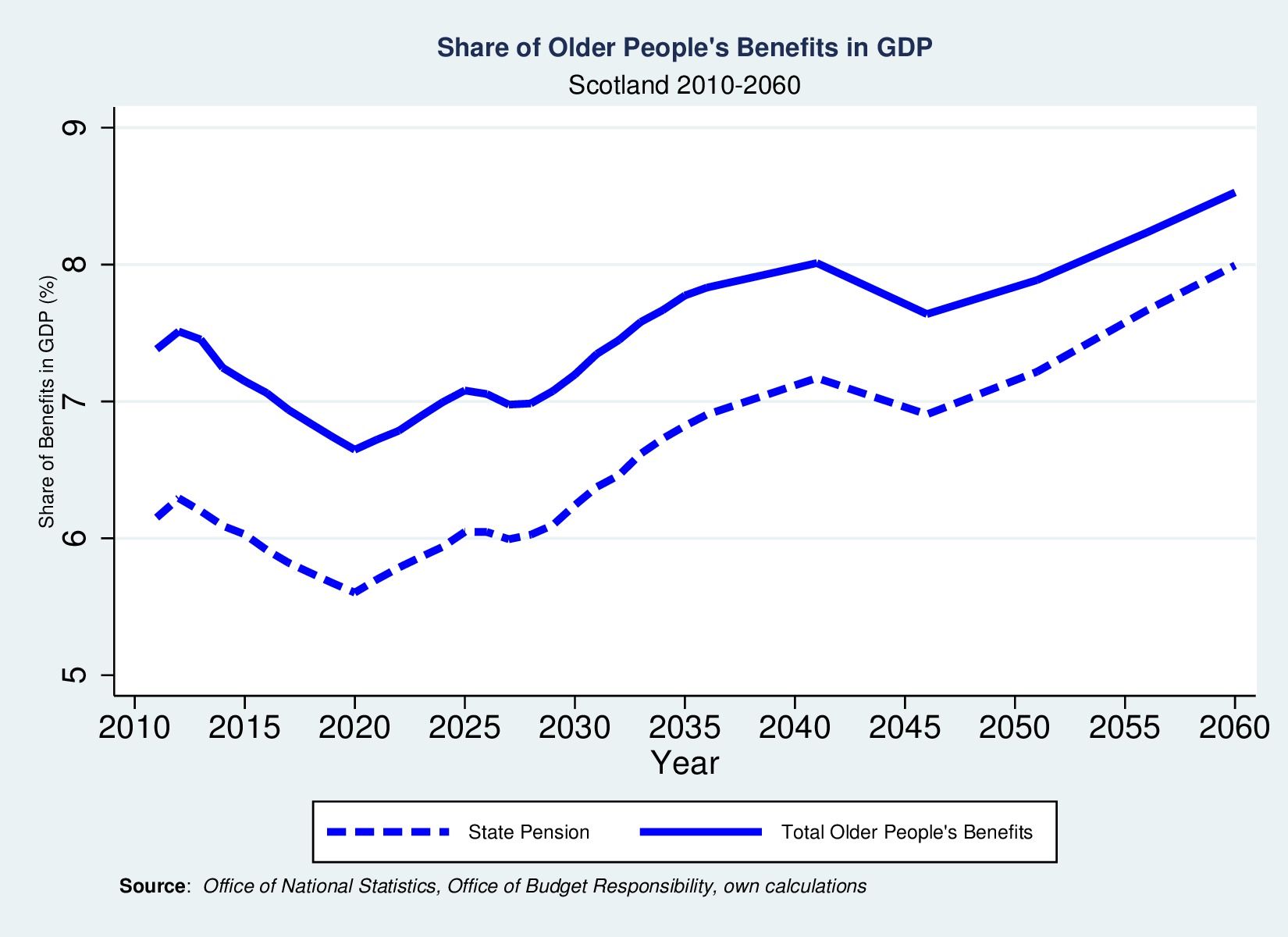
To illustrate this, the next figure shows a projection of the costs of older people’s benefits in Scotland measured as a share of GDP over the period 2010 to 2060. This is based on the OBR forecast of the future costs of older people’s benefits [1] in the UK as a whole.  The projection for Scotland is based on the assumption that costs will largely be determined by Scotland’s share of UK pensioners.  If economic performance in Scotland follows that assumed by the OBR for the UK as a whole, and, in particular, worker productivity grows at 2.2 per cent per annum for the period to 2060, then the share of older people’s benefits in GDP would be broadly as shown in Figure 8.

The projection shows pensioner benefits falling as a share of GDP until 2020 and then rising. The reason for the dip during this decade is mainly due to the increase in retirement ages, particularly for women. Thereafter costs trend upward with increasing numbers of pensioners, though they dip after 2040 due to a further projected increase in the retirement age. Another key assumption that affects disability benefits (and also health spending though this is not included in these projections) is that of healthy life expectancy (expected years of disability free life). The OBR assumption is that healthy life expectancy will grow in line with life expectancy at age 65. This assumption is therefore implicit in the projections for Scotland, although, given the earlier discussion of its higher incidence of disability, significant improvement in healthy life expectancy poses a particular challenge for Scotland.

While state pensions dominate benefit payments for older people, other benefits such as AA, DLA and WFP also contribute to the total cost. Their relative contribution is expected to decline over time due to their value being uprated in line with CPI, rather than with the “triple-guarantee [2]” which will apply to state pensions.

Figure: Projected Costs of Older People’s Benefits as a Share of GDP Scotland: 2010-2060

Figure: Projected Costs of Older People’s Benefits as a Share of GDP Scotland: 2010-2060

Figure: Share of Old Age Pensions in GDP if Annual Productivity Growth Reduced by 0.5 per cent

Figure: Share of Old Age Pensions in GDP if Annual Productivity Growth Reduced by 0.5 per cent

Another critical assumption on the OBR projection is that of consistent productivity growth of 2.2 per cent per annum. A fall in this growth rate would place increased pressure on the public finances. For example, a reduction of 0.5 per cent per annum substantially increases the share of GDP devoted to older people’s benefits (see Figure 9). The lower (dashed) line replicates the central OBR assumption of 2.2 per cent productivity growth, while the upper (continuous) line assumes 1.7 per cent growth. This increases the share of GDP going to older people’s benefits by almost 1 per cent by 2035.


[1] These benefits and the assumptions underlying their evolution are: State Pension Age equalised at 65 by November 2018, with the Pension Credit and Winter Fuel Payment qualifying ages rising in line. State Pension Age reaches 66 by October 2020, and rises further to 67 between 2026 and 2028, and 68 between 2044 and 2046; qualifying ages for Pension Credit, winter fuel payments, Disability Living Allowance and Attendance Allowance rise in line.  Basic State Pension uprated using the ‘triple guarantee’ mechanism which is assumed to cause it to grow by earnings growth plus 0.26 percentage points a year. State Second Pensions in payment uprated in line with CPI.

[2] The “triple guarantee” means that state pensions will rise by the greatest of: (1) the rise in average UK earnings, (2) the rise in inflation (as measured by the Consumer Price Index) and (3) 2.5 per cent

Posted in Welfare and Social Policy | Leave a comment

Women, gender equality and constitutional change: lessons from Catalonia and Scotland

This blog, written by Meryl Kenny (UNSW) and  Tània Verge (Universitat Pompeu Fabra) draws on discussions held at the Women and Constitutional Futures Seminar: Gender Equality Matters in a New Scotland held on 14/15 February 2013 at the Royal Society of Edinburgh and the STUC Women’s Conversations event held on 18 February 2013. It was originally posted on Gender Politics at Edinburgh

Catalonia

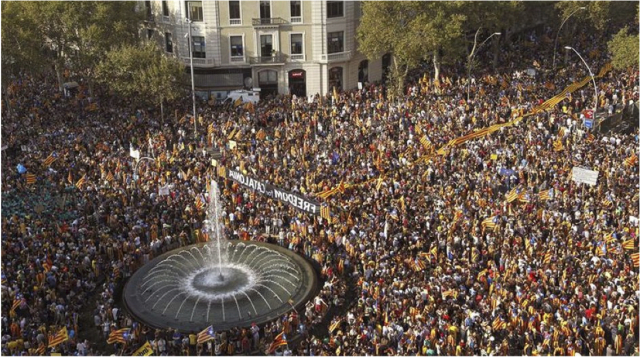
On 11 September 2012, almost 2 million people – a quarter of Catalonia’s population – rallied in the streets of Barcelona in support of independence. Early elections were immediately called to give the new Catalan parliament a clear mandate to negotiate with the central Spanish state over the right to self-determination and the governing Catalan parties set a time limit for calling a referendum in 2014, the same year that Scots will be asked if they want independence. In this blog, we explore the parallels between the Catalan and Scottish experiences of constitutional change and evaluate the implications of these processes for women and for gender equality, focusing particularly on women’s political representation.

Setting the context

Why is Catalonia pushing for independence? This is largely to do with Catalan dissatisfaction with the territorial accommodation within the Spanish state, which does not recognise national differences, is reluctant to concede additional powers to the autonomous communities, and which has begun to recentralize its political authority. There are also concerns over the erosion of protections for the Catalan language. Finally, economic arguments for independence have contended that Catalonia is financially discriminated against by the Spanish state and argued for the need for full fiscal capacity, particularly in light of the economic recession.

Yet, in Catalonia and Scotland, women’s voices and debates over gender equality have been largely missing from wider discussions over independence and constitutional change.

The Spanish government’s initial reaction was dismissive, accusing nationalist parties in Catalonia of attempting to divert attention from their own economic policies. But consistent support for independence – with public opinion polls indicating that 57% of the Catalan population supports secession – has subsequently prompted more aggressive public rhetoric and legal action by the Spanish government, including lodging an unconstitutionality appeal against the Catalan parliament’s declaration of sovereignty. While referendums can be called by the central government, there is no scope for secession, as the Spanish constitution establishes a single, indivisible sovereign unit, the Spanish people.

In Scotland, processes of constitutional change have also been dominated by debates over legality, with initial questions raised as to whether Scotland had the power to enact a referendum bill, given that the Union is a matter reserved to the UK Parliament. These issues were resolved by an executive pact between the Scottish and UK governments, in the form of the Edinburgh Agreement, which allows the Scottish Parliament to stage a vote on independence in 2014. The price paid for this agreement has been the decision to hold a single-question yes/no referendum on independence, rather than include an additional option in the form of ‘devo-max’ – a potentially more popular option which would have transferred additional powers from Westminster to the Scottish Parliament.

How women are (not) mobilizing

Where are women in these debates? Constitutional change offers ‘windows of opportunity’ for equality agendas, offering traditionally marginalized actors and groups a chance to stake their claims at the beginning of the process. Yet, in Catalonia and Scotland, women’s voices and debates over gender equality have been largely missing from wider discussions over independence and constitutional change. As Christine Bell and Fiona Mackay argue, this can be explained in part by the focus thus far on issues of legality and process, an emphasis which has the potential to exclude women and women’s issues from the debate.

Additionally, in both cases, divisions on the left, prevailing adversarial politics and strong party discipline have made cross-party or cross-sectional alliances difficult to form, making it hard to put women’s policy concerns on the agenda. In Catalonia, feminist activists are divided on independence, reflecting the division among left-wing political parties. While one party is clearly supportive of independence (ERC, Republican Left of Catalonia, the equivalent to the SNP with less parliamentary support), two-thirds of green voters (ICV, Initiative for Catalonia Greens) support independence and the Catalan social-democrats (the PSC, Party of the Catalan Socialists) are highly fragmented – one-third of their voters support independence, one-third oppose it, and one-third are undecided. As a result, the PSC party leadership, without allowing for debates among the party membership, has decided to advocate a third option – the federalization of Spain (a rough equivalent to ‘devo-max’) – but this option is not supported by most unionist supporters and is completely rejected by secessionists. The overall focus on process has also not provided much room for substantive debates thus far, including gender equality issues.

In Scotland, the relative absence of women and debates around gender equality in the run-up to the 2014 referendum – with the exception of some women’s groups and grassroots networks like Women for Independence – stands in contrast to how involved women were with processes of constitutional change in the 1990s. As Professor James Mitchell noted in last week’s Women and Constitutional Futures Seminar, the debate in Scotland has been both ‘arid and adversarial.’ While in Catalonia, there is a cross-sectional party coalition behind independence – incorporating not only the left-wing ERC, but also the centre-right CiU – in Scotland, the debate has been more polarized. And, while a majority of both men and women in Catalonia support independence, in Scotland, support is lower, with recent polls indicating that 34% of likely voters back independence, making it more difficult to form broader coalitions & alliances. Notably, there has been a persistent gender gap in support for independence, with 41% of men planning to vote Yes in 2014, but only 28% of women (with 11% of both sexes undecided). While some mainstream commentators have attributed this gap to women being ‘less political’ and ‘more hesitant’, others point out that this is arguably a rational response to the lack of information from both camps about what the everyday implications of the different constitutional options might be and what they might mean in terms of women’s lives and gender equality more broadly.

What does constitutional change mean for women and for gender equality?

What issues might bring women into the debate? In the run-up to Scottish devolution in the 1990s, the key issue that served to rally women activists from all walks of life was the call for 50:50 representation. There was a broad political consensus over the need for equal representation in the new Scottish Parliament, and, following a sustained and strategic campaign both within and outwith the main Scottish political parties, substantial proportions of women MSPs were elected in the first elections to the Scottish Parliament in 1999. The current constitutional ‘moments’ in Catalonia and Scotland provide a key opportunity to revisit these wider debates. Constitutions capture aspirations for the future, setting out broader principles of fair treatment and representation and offering possibilities for inclusion and equality, or conversely, exclusion and inequality. Constitutional change in both cases, then, provides a crucial opportunity to introduce and enshrine gender parity as a public good.

Both countries have performed relatively well on women’s representation. In Catalonia, the current parliament has 40% women deputies, which would place it tenth in world league tables on women’s representation – above countries like Iceland, Norway and Denmark. In Scotland, just under 35% of MSPs elected in 2011 were women, which would put the Scottish Parliament at position 22 in the world league tables (compared to the UK House of Commons, which ranks 57th). In both cases, gains were achieved through the use of gender quotas. In Catalonia, the state-wide Spanish statutory quota passed in 2007 establishes that party lists must include a minimum of 40 per cent and a maximum of 60 per cent of either sex. However, this quota simply consolidated an ‘incremental track’ initiated by party quotas decades earlier. Thanks to parties’ voluntary measures, when the statutory quota was passed in 2007, women’s representation already reached 36%. Women’s agency was crucial in persuading left-wing parties to adopt quotas in the 1980s and to enlarge these initial provisions to parity levels in the following decades, as well as in ensuring that these quotas were effectively enforced by party bodies. In Scotland, the high numbers of women MSPs are largely due to the use of strong gender quotas by the Labour Party in 1999 – in the form of a mechanisms called twinning for constituency seats, as well as zipping on the regional lists – and informal measures adopted by its main electoral rival the SNP in 1999, including favourable placement for women candidates on regional lists. As a result of these measures, 50% of Labour MSPs elected in 1999 were women, as well as 42.9% of SNP MSPs, numbers which continue to have an impact on headline figures post-1999.

However, even if levels of women’s political participation are (relatively) high in both Catalonia and Scotland, it is important to avoid complacency. Indeed, in both cases, issues in the short-term political agenda point to the need for vigilance to ensure that women and their perspectives are represented in debates over constitutional change. In Catalonia, for example, the government’s recent establishment of a Council for the National Transition raises potential issues with regards to women’s representation. While commissioners have not yet been appointed, feminists have reasons to worry about its gender composition: this very same government only included three women ministers in the so-called ‘government of the best’ selected to manage the economic crisis. The Council will be a consultative body that will act as an international ambassador of the Catalan cause, therefore, its gender composition will have strong symbolic and substantive effects for women’s representation. Meanwhile in Scotland, despite the high levels of female politicians and the prominent role of Deputy First Minister Nicola Sturgeon in the Yes campaign, the face of Scottish politics remains relatively ‘male, pale and stale’. While some women’s voices have been heard, the majority of platforms and panels launched by the SNP or the Yes campaign, as well as the resulting media commentary, have been largely male-dominated. Indeed, as others have noted, the Scottish Government’s Expert Working Group on Welfare, unveiled by Nicola Sturgeon in early 2013 to evaluate the potential structure of the welfare system in an independent Scotland, was initially men-only.

Questions in both cases have also been raised as to the sustainability of current levels of women’s representation. In both contexts, gender quotas are not yet taken for granted, and vigilance is required to ensure that quota measures are effectively implemented and enforced, and that women are selected for winnable positions. In Catalonia, new electoral legislation is due to be passed in the next few months which could diminish the effectiveness of the state-wide Equality Law. A long-standing debate on political disaffection among citizens and current corruption scandals by political parties has prompted calls to shift towards a candidate-oriented system with smaller districts and open lists. The parliament will resume the discussions that were started several years ago when an expert commission issued a report on the reform of the electoral system – a commission which included 7 experts, all men, and whose 150 page report included only one page devoted to gender equality in representation. While these experts were happy to keep the current statutory quota, they also suggested changing district magnitudes, the electoral formula and the type of lists – changes that would render the application of the Equality Law completely ineffective.

In Scotland, there are clear signs that gender parity is slipping down the political agenda. There is little evidence that gender quotas have ‘caught on’ since 1999, either across political parties or different political levels. Any progress since the first elections has been brought about more by accident than design, and gender quotas and gender balance remain poorly institutionalized within Scottish parties, with a detrimental impact on the recruitment and election of female candidates over time. It seems unlikely at this point that the other Scottish parties (with the exception of the Greens) will follow Labour’s lead and adopt strong gender quotas. This raises the question as to whether the time has come to consider statutory quotas in Scotland, following the examples of Spain, Belgium, France, and also the Republic of Ireland, where 30% candidate gender quotas are now law. Regardless, lessons from Catalonia and Scotland point to the need to keep gender parity on the agenda, and to ensure that quota measures are well-designed and well-implemented, with effective supervision mechanisms and sanctions for non-compliance.

Women’s political inclusion – in both the short and the long-term – can be one key issue around which women can gather and build broad consensus around different groups.

As we discussed at the Women and Constitutional Futures Seminar, women’s issues are constitutional issues. Thus, regardless of the results of the respective national transitions, it is vital that women’s voices and perspectives be included in wider debates over institutional and constitutional restructuring. In both Catalonia and Scotland, women must seek to engender both sides of the debate and hold them to account. Women’s political inclusion – in both the short and the long-term – can be one key issue around which women can gather and build broad consensus around different groups.

Posted in Referendum process, campaign and vote | 1 Comment

Another Independence Referendum in 2014? Recent Developments in Catalonia

Constitutional lawyer, Dr Elisenda Casanas-Adam, describes the parallel process towards a (potential) constitutional referendum in Catalonia, and suggests that it may have implications for Scotland, especially in relation to EU membership.  

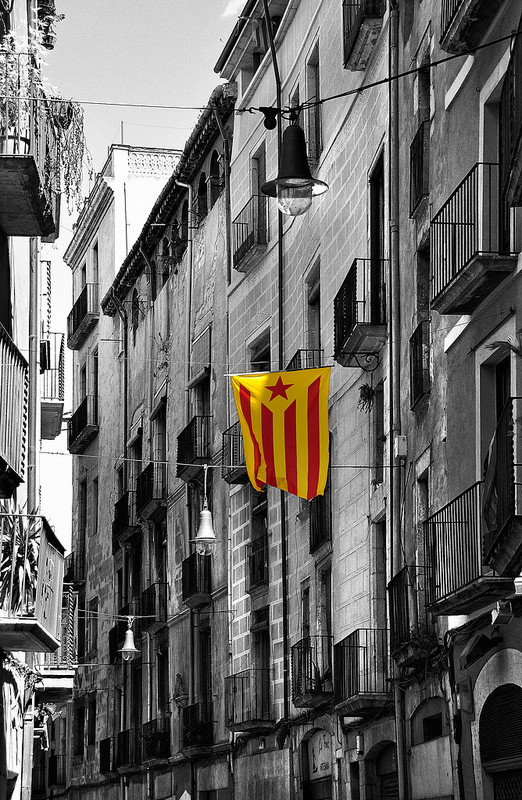
Catalan Flag

Keith Ellwood, ‘Catalan flag Girona’, 29 April 2012 via Flickr. Creative Commons Attribution.

Last month the Catalan Parliament adopted a ‘Declaration of Sovereignty of the Catalan People’ (85 votes in favour, 41 against and 2 abstentions), as the first step in its plan of ‘National Transition’, leading up to the holding of a referendum on the constitutional future of Catalonia in 2014. The declaration was jointly proposed and endorsed by the Catalan Government (governed by Convergencia i Unio – CIU) and the main party in the opposition (Esquerra Republicana de Catalunya – ERC), among others (Iniciativa per Catalunya Verds – ICV, one ‘critical vote’ from Candidatura d’Unitat Popular – CUP).

With both levels of government preparing their constitutional strategies, the situation is being described as ‘two trains driving toward each other’.

The debate in the Parliament also included the consideration of an alternative declaration (Partit dels Socialistes de Catalunya – PSC) on ‘The right to decide of the people of Catalonia’, which omitted any reference to ‘sovereignty’, and provided specifically that the process would require an agreement with the Spanish Government and should guarantee a plurality of options. Considered together, and despite their important differences, the overall support for the right of Catalonia to decide its own constitutional future (‘dret a decidir’) is almost 80% of the members of the Parliament.

The Declaration of Sovereignty was adopted in defiance of the Spanish Government (governed by Partido Popular – PP), which has made clear that it considers a Catalan referendum would be in violation of the Constitution and has stated it will use all legal avenues available to stop it. So far, the Government has not taken any action against the Declaration because it is a political document, but the urgent report it requested from its legal services has recommended that the Declaration be challenged before the Constitutional Court. With both levels of government preparing their constitutional strategies, the situation is being described as ‘two trains driving toward each other’.

Where the influence of developments in Catalonia might be felt more in Scotland is in attempts to negotiate with the European Institutions, as both Catalan and Spanish Governments are putting them under a lot of pressure. A possible breakaway-independent Catalonia is much more problematic for the EU than a possible negotiated-independent Scotland, but in order to avoid having to face the former they might make the procedures for accession of newly-independent regions very complicated for all possible candidates.

Background

The current process began on the 11th September 2012, (the Catalan ‘Diada’, commemorating the fight for Barcelona in 1714), when one and a half million people came out into the streets in Barcelona in support of independence for Catalonia. The Catalan Prime Minister, Artur Mas (CIU), called new elections to secure a mandate to hold a referendum and lead the process of ‘national transition’ to ‘Catalonia’s own state’. These elections became a pre-referendum in themselves, with Catalonia’s right to decide and the different options for its constitutional future being the central focus of all parties (the austerity measures were also an important element). The results supported the holding of a referendum but strengthened the more hard-line ERC, with which Artur Mas has now had to reach an agreement to take his plan forward. The most notable losers, however, were the PSC and their intermediate federal option, which proposed a reform of the Constitution in order to improve the position of Catalonia within the overall system.

After the election, one of the central points of the agreement between CIU and ERC is to hold a referendum on Catalan Independence in 2014. Deciding on the date for the referendum actually delayed the agreement, as ERC initially insisted on having it in 2013. This agreement also sets out a plan for the process of ‘National Transition’ of Catalonia, with five different steps:

  1. Declaration of Sovereignty of the People of Catalonia (first plenary session);
  2. Enactment of a Statute on Consultations (beginning in January);
  3. Start of negotiations with the Spanish State in order to reach an agreement on holding a referendum;
  4. Creation of a Catalan Council for National Transition;
  5. To have everything set up by the end of 2013 in order to hold the referendum in 2014. This can, however, be postponed by agreement between both parties.

Following the above, the Declaration of Sovereignty was adopted on 23 January and provides that, in accordance with the will of the people of Catalonia, the Parliament agrees to start the process towards them exercising their right to decide their collective political future. It then sets out the principles that will guide this process: Sovereignty, Democratic Legitimacy, Transparency, Dialogue, Social cohesion, Europe-ism, Legality, Principal role for the Parliament and Participation. Since then, the Catalan Government has approved the creation of the Advisory Council for National Transition, as an expert body to advise it on the legal and technical aspects of the process, and has proposed the establishment of a cross-party committee on the ‘right to decide’ in the Catalan Parliament, which will include representatives from civil society and local government (‘Catalan Pact for the Right to Decide’). The Parliament itself has also agreed to restart the debates on a Statute on Consultations, which had begun in the previous session, with an ample majority (CIU, ERC, PSC and CUP – ICV wanted the cross-party committee to be set up first).

The legality issue

Specialised legal opinion is divided on whether Catalonia could hold a referendum within the current constitutional framework. Arguments against it are based on Arts. 1 and 2 of the Constitution, which provide that ‘National sovereignty belongs to the Spanish people’ and that ‘The Constitution is based on the indissoluble unity of the Spanish Nation’, and on the exclusive competence of the central state over the ‘Authorization of popular consultations through the holding of referendums’ (Art. 149.1.32). It has, therefore, been put forward that the referendum would require the consultation of the whole of the Spanish people, or could not be held without a previous reform of the Constitution in this sense.

On the other hand, arguments in favour of the possibility of Catalonia being able to hold a referendum within the current constitutional framework are based on the democratic principle, also in Art. 1, which is one of the foundations of the system and informs the interpretation of the rest of the constitutional text. Acknowledging that independence would require a reform of the Constitution, it has been suggested that the referendum could be formulated as a consultation to Catalan citizens on the initiation of such a reform. The possible mechanisms for this would be either a referendum with the authorisation of the central authorities (on the basis of a state or Catalan statute), or a ‘non referendum-consultation’, which would then not require authorisation. In accordance with the Constitutional Court’s case law, this could then not be based on the electoral register and could not involve the institutions or benefit from the safeguards of the ordinary electoral procedure (SSTC 103/2008).

Even if they follow the ‘non-referendum consultation’ option, which seems to be the Catalan Government’s current preference due the central state’s clear opposition to the referendum, there is a strong possibility it would be challenged before the Constitutional Court. In this case, previous case law seems to indicate the Court will not be very receptive to claims that Catalonia is a sovereign people and can decide its own constitutional future (SSTC 103/2008 and 31/2010). It has, however, accepted that Catalonia has the competence to hold ‘non referendum consultations’ more generally.

If, as they are threatening to do, the Catalan Government goes on with the consultation regardless, the Constitution authorises the Central authorities to take all measures necessary if ‘a Self-governing Community does not fulfil the obligations imposed upon it by the Constitution or other laws, or acts in a way that is seriously prejudicial to the general interest of Spain’ (Art. 155). As a last resort, even the armed forces could be used in order to secure the “integrity” of Spain’s territory (Art. 8).

There is still another possibility, at least in theory: the Constitution enables the Spanish Government to hold referendums on political issues of special importance (Art. 92). Such a referendum would not be legally binding, but its results would show the strength of the support for independence, and, at the same time, put a stop to the allegations that the central government is undemocratic. A well respected constitutional lawyer (Rubio Llorente) has suggested that this could be a way to ease the tension.

The European Union 

The European Union is also playing a central role in this debate, to the extent that ‘Catalonia, new state of Europe’ was the slogan of the initial pro-independence march on September 11th 2012. Following the same line, Artur Mas’ first proposed question for the referendum was ‘Would you like Catalonia to be a new state of the European Union?’, and both the government agreement between CIU and ERC and the Declaration of Sovereignty also refer specifically to the holding of a consultation on Catalonia becoming a new State ‘of Europe’ or ‘within the European Framework’.

Interestingly, the process of ‘National Transition’ itself is also being presented as located within the wider European constitutional framework. The Declaration of Sovereignty states that the process will defend and promote the founding principles of the European Union (‘Europism’) and will involve dialogue and negotiation with the Spanish state, the European Institutions and the international community (‘Dialogue’). Evidence of this is also that Catalan citizens and Members of the European Parliament have appealed to different EU Institutions to obtain some recognition and even protection for Catalonia from Spain. The European Institutions have so far been largely unreceptive and, after making some comments that seemed to open the door for an independent Catalonia automatically becoming part of the EU, Viviane Reading, Vice-President of the European Commission and Commissioner for Justice, Fundamental Rights and Citizenship had to write a letter to the Spanish Government apologising and stating that the EU could not recognise a unilateral declaration of independence of a part of one of its Member States.

Independence and other options 

Although there is a strong majority in the Catalan Parliament in favour of Catalonia’s right to decide its constitutional future, there is a diversity of positions on what the final outcome of the process should be.  Even within the governing coalition party, there are different opinions about the final objective of the ‘National Transition’. Options include ‘full independence’ (Convergencia Democratica de Catalunya, ERC, CUP), a ‘confederation with the Spanish State’ (Unio Democratica de Catalunya), and different forms of ‘federalism’ (ICV and PSC).  As the legitimacy of their claim for the ‘right to decide’ is based on their strong majority, they are now faced with the complicated task of formulating a referendum (or consultation) question that has the agreement of all parties, and there have already been some suggestions of including different options apart from the status quo. On the other hand, the Catalan PP, which is opposed to the ‘right to decide’, has also announced it will put forward a proposal for a change in the financing system of Catalonia, as the ‘constitutional’ alternative to the above.

Implications for Scotland?

There is no doubt that events in Scotland are influencing those in Catalonia. If both referendums are to be held in 2014, the question then becomes whether events in Catalonia might influence those in Scotland. One way in which Catalonia could influence Scotland would be by increasing the level of confrontation between the ‘yes’ and ‘no’ campaigns, although this seems unlikely. A second possibility would be by bringing the possible third option/second question back into the debate, although the current process seems a bit too far ahead for that. Where the influence of developments in Catalonia might be felt more in Scotland is in attempts to negotiate with the European Institutions, as both Catalan and Spanish Governments are putting them under a lot of pressure. A possible breakaway-independent Catalonia is much more problematic for the EU than a possible negotiated-independent Scotland, but in order to avoid having to face the former they might make the procedures for accession of newly-independent regions very complicated for all possible candidates.

Dr. Elisenda Casanas-Adam is a Lecturer in Public Law and Human Rights in the Edinburgh Law School. An earlier version of this article appeared on the Scottish Constitutional Futures Forum blog

Posted in Overseas Perspectives | Leave a comment

Shining a Light on Social Justice in Scotland

Robin McAlpine, Jimmy Reid Foundation

Robin McAlpine, Jimmy Reid Foundation

As part of our series on social welfare and the independence referendum, Robin McApline, Director of the Jimmy Reid Foundation, welcomes that the referendum is focusing attention on prevailing levels of poverty and inequality in Scotland and the UK, and urges both sides to put social justice at the heart of their campaign.

Nothing allows daylight to flood in quite like opening the curtains. Time spent in an enclosed space with your eyes focussed on a point away from the outside world affects your vision. Things seem duller, perspective and dimensionality are lost.

And so it is that the independence debate has refocused minds on the question of social democracy and what it means. This is not to grant one side or another in the debate credit with changing the perspective alone; but by starting to think about the possibility of a social order which isn’t only informed by the British (and US) social model has forced everyone to clarify their vision.

As the horizons of the debate are stretched, unwillingly, from our island up to the north and out to the east, light is cast on our social democracy. And it is not a sympathetic light.

Why is this so? Because Britain is a surprisingly parochial country when it comes to sources of inspiration and measures against which to assess ourselves. For a long time Britain (often as a direct result of campaigns by the right-wing media) has tried hard to obscure Europe from us. The story became always about ‘what’s wrong with Europe’ and why we wouldn’t want to be like them. Straight bananas and all that.

At the same time, this story has been curated almost literally to disorientate us – orientate originally meaning to look east. Instead, we have had a strange distorting medium between us and things to the north and to the east. The US has far too often become our chosen frame of reference. This is partly linguistic, partly cultural, but mainly political.

For generations Britain saw itself as a bridge between Europe and the US, which always reminds me of the line in Shakespeare in Love where the character playing the nurse describes Romeo and Juliet by beginning “so, there’ this nurse…”. In the second half of the 20th century Britain was an important US asset in Europe, but the intellectual traffic was one way. We learned much about America’s obsessions (small government, laissez faire, individualism) but evidence that they learned much about Europe’s is much more limited.

The outcome of this has been that Britain has remained stubbornly unwilling to learn political lessons from anywhere to its east or north. Scandinavia has always been dismissed sniffily as a ‘peculiar and specific’ social model. It is rejected as a social model for tenuous reasons, primarily relating to a US assumption that low tax is always the preferred choice – and this against the evidence.

The European social model is one we think belongs separately to Britain. It is as if we are an island broken off from a continent, an island in which political evolution took a different course from the mainland, producing a unique and self-contained social order. This isn’t true; it was very much part of a continent that was struggling its way into a post-war settlement that could do nothing other than build something better among the ruins. We just don’t see it that way. We imagine Britain to be self-contained.

We were celebrating the ideal of the NHS at the very point where its founding principles were being discarded.

To my eyes, this mindset seemed to reach its turning point in Danny Boyle’s Olympics opener. That we took so much pleasure in hundreds of underpaid nurses dancing for free for corporate sponsors while the pernicious deregulation of the NHS in England was ploughing its way through Parliament seemed to me to present a major disjuncture. This wasn’t a birthday party; we weren’t celebrating something in rude health. It wasn’t a funeral; we weren’t mourning the loss of a loved one. It was like we were dancing round the room dragging a corpse with us. We were celebrating the ideal of the NHS at the very point where its founding principles were being discarded.

I would not suggest this is yet a widely-shared view in Scotland, but I think we’re getting there. Both sides of the referendum campaign are now starting to present their vision in terms of social democracy. Scottish Labour is rediscovering vocabulary like ‘redistribution’ which seemed totally absent in the Blair years.

And so, perhaps no single piece of information has more fired the development of the independence campaign than this – Britain is the fourth most unequal country in the world and it is getting worse. As the horizons of the debate are stretched, unwillingly, from our island up to the north and out to the east, light is cast on our social democracy. And it is not a sympathetic light.

Almost three out of four people in Scotland get by on less than £24,000 a year. That’s the average salary. Two out of five people get at least 40 per cent of their income from benefits and welfare. More remarkably, four out of five Scots get at least 15 per cent of their income from benefits and welfare. Poverty has never been properly tackled and is now getting worse.

There is no doubt that this is a less comfortable light for the No campaign. In no sense can you compare Britain to comparators like Germany or France and conclude that our social democracy is a triumph. When Scotland looks to the Nordic countries, many of our socioeconomic statistics look positively medieval. One of the reasons the No campaign is so uncomfortable with allowing conversations to drift towards what Scotland could be like if it was independent is that it is hard to see how we could be much worse in social democratic terms. There are only four ways we could end up worse: become Turkey, Russia, the US or a third world country. In that context, pointing to a 60-year-old NHS to prove that Britain can still take pride as a country of equality rings hollow.

In a debate between The Daily Mail and The Daily Telegraph, Britain’s problems relate to too much social democracy. That has been the UK perspective. Look outwards and things seem different.

Does this mean that only supporters of independence can have any case to make on social democracy? No, it certainly does not. The No campaign and its supporters could build a strong case for how Britain as a larger nation has more scope for internal redistribution, which in turn could lift a larger number of people out of poverty than we could do in Scotland alone. What it can’t seriously argue is that this is happening – or has happened at any time in my lifetime. Since I learned to talk, social mobility and socioeconomic equality have been redistributed in the wrong direction.

Does this mean that independence supporters have social democracy in the bag? Definitely not. As some people have put it, to fight an independence campaign, to win, and to then discover that the only outcome is to become the fifth most unequal country in the world would be truly awful.

Here’s the thing though; the No campaign has made no suggestion so far on how to achieve a more socially-democratic Britain. It has resorted to implying that what we have is as good as it gets. And while there is much to poke holes in so far, the Yes campaign has at least taken the issue of equality seriously.

If one outcome of the independence debate is that, in the glare of daylight, Scotland is forced to stand naked in front of the mirror, it will have done us a service. The best moment in US TV series The Newsroom was its first moment. Asked by an audience member to succinctly explain why America is ‘the greatest country in the world’, the lead character responds dryly that it isn’t.

Whatever becomes of Better Together, it will have done Scotland no favours if it continues to pretend that Britain is the best social democracy we are permitted. With the curtains open, it really is time to own up to just what a state the State has become.

Robin McApline is Director of the Jimmy Reid Foundation

Posted in Welfare and Social Policy | Leave a comment

Changing Politics: The ‘Thinking Together’ Citizens Assembly

So Say Scotland

So Say Scotland

The University of Edinburgh’s Oliver Escobar shares the So Say Scotland initiative, an effort to insert principles of deliberative democracy in the debate over Scotland’s constitutional future and ‘reclaim politics as the business of the people’.

A few weeks ago the Scottish Government published an outline of the route plan from the referendum to independence and the creation of a written constitution. Most notably, it acknowledged that a central dimension in that process is to “learn from the innovative and participative approaches of other countries” (p. 2) in order to  “engage all the people of Scotland” (p. 6) in shaping their constitutional future. Similarly, the Better Together camp is also arguing that civic engagement is a fundamental dimension in the run up to the referendum.

The idea is to recast democracy as a domain of citizen participation, dialogue and deliberation, and thus reclaim politics as the business of the people.

So here we have a critical landslide of invaluable common ground between the Yes Scotland and the Better Together campaigns: the future belongs to citizens, and it should be citizens who work it out through public dialogue and deliberation. The question is: How can we materialise those ideals into meaningful practices? In this blog post, I would like to share with you how such participative process has already begun (independently from either of those campaigns) thanks to the ingenuity and hard work of a network of democratic innovators. Notwithstanding the results of the referendum, we believe that we need new ways of doing politics, and new pathways for democracy.

On February 28th 2013, the first ever ‘Thinking Together’ Citizens Assembly will take place in Scotland. Its aim is to assemble a cross-section of the Scottish population to engage in facilitated dialogue to create a collective vision for the future of the country. The process is organised by So Say Scotland, a non-partisan, non-profit, unincorporated association, powered by a network of social entrepreneurs, researchers and volunteers from all walks of life. The project is supported by a wide range of organisations and individuals who are contributing in cash or in kind, including platforms such as SCVO and the Public Policy Network (part of Edinburgh University’s Academy of Government).

The mind-boggling preparations have brought together a team of over 70 volunteers masterfully coordinated by Susan Pettie and Zara Kitson, including 25 dialogic facilitators recruited and trained for the occasion by Wendy Faulkner in collaboration with Oliver Escobar. All this work is being carried out on a minimal budget, and very much depending on the goodwill of volunteers and ongoing calls for public support through micro-funding. To support our efforts, donate here. All donations go towards basic needs for the event (i.e. catering, facilitation materials) as well as to ensure that citizens with low incomes or those living at a distance are able to participate.

The ‘Thinking Together’ Assembly takes its inspiration from the Icelandic Visioning Forum that formed the basis for the innovative democratic process leading to the recent creation of Iceland’s new constitution –after the country’s financial and political collapse. This was the world’s first ‘crowd-sourced’ constitution, that is, a constitution made directly by citizens through public dialogue and deliberation.

In Scotland, the ‘Thinking Together’ Assembly seeks to create a vision to inform the future of the country, notwithstanding the result of the 2014 referendum. The premise is simple, this first Assembly will gather 192 citizens (selected to represent as much as possible the demographic diversity of the Scottish population) to engage in a full day of facilitated dialogue. The process involves seven creative stages, designed to share and agree upon key values and ideas, and then build on them to articulate specific pathways towards a collective vision that captures a diversity of views and priorities. This dialogue process is carefully facilitated to be inclusive and highly sensitive to differences and minority views.

All the creative work done by the participants will be processed live by the tech-team, and a small army of volunteers will carry on doing data entry after the event. The results will be made public in the Thinking Together Report to be launched at noon on the day after the Assembly. We will distribute it far and wide, so that networks and organisations around the country may use it to inform their current and future work.

Other outputs will include future publications and talks (the first one in March at Changing Scotland) given by the many volunteers working to make the Assembly the best it can be. This includes Ailsa Henderson and Oliver Escobar (University of Edinburgh) and Stephen Elstub (University of the West of Scotland), who lead the research team for the Assembly.

So Say Scotland aims to become a hub for democratic innovation, harnessing the capacity, creativity and passion of citizens around the country to find new ways of tackling the pressing issues of our time. The ‘Thinking Together’ Citizens Assembly is, therefore, the first milestone in that change-making journey. The idea is to recast democracy as a domain of citizen participation, dialogue and deliberation, and thus reclaim politics as the business of the people.

Find out more and join us: www.sosayscotland.org

For an introduction to public dialogue and deliberation: http://bit.ly/125D0U7

Posted in Policy - General | 2 Comments

Glasgow University’s Referendum: A sign of things to come?


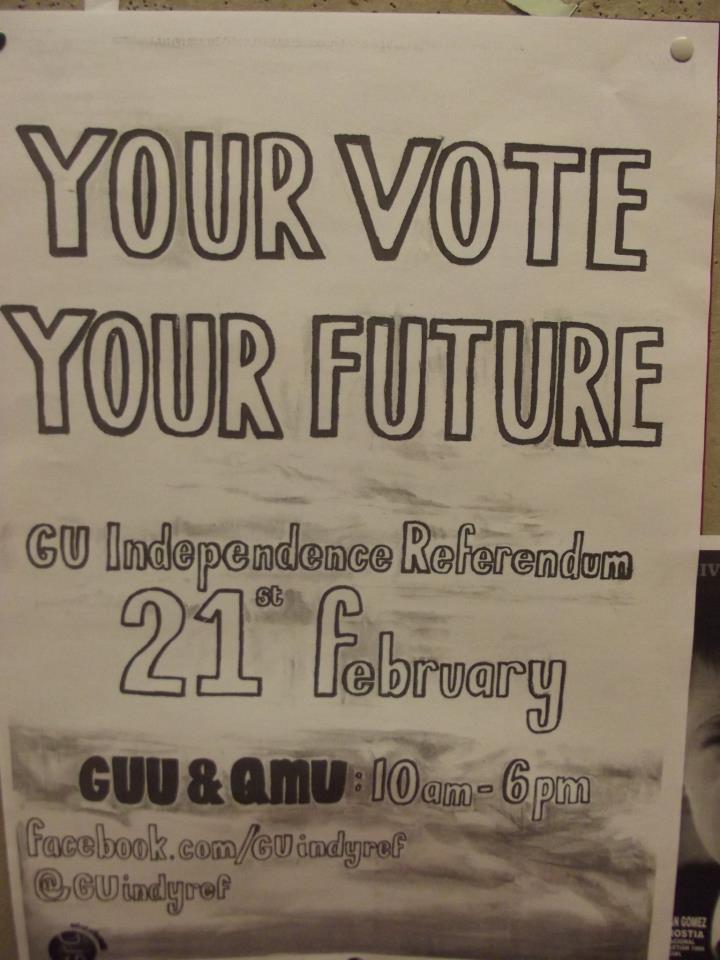
Your Vote, Your Future

Your Vote, Your Future

Charlotte Snelling, a postgraduate researcher on youth participation and engagement reflects on Glasgow’s mock referendum on independence, cautioning against viewing the exercise as indicative of youth turnout and preferences in 2014.

On Thursday, students at the University of Glasgow took to the polls in the first high profile mock independence referendum since the Edinburgh Agreement was signed. Both the official Yes Scotland and Better Together campaigns were well represented on campus, supplying campaign materials and resources to the student groups representing them and even politicians themselves joining the campaign trail to rally supporters, highlighting the significance each side were attaching to the event. The result saw just under two thirds (62 percent) of students voting in favour of maintaining the union but what, if anything, can really be learnt from this?

The result was reported by the media as a blow to the Yes campaign and to the Scottish National Party. The 18 to 24 year old electorate is widely considered a key constituency for the pro-independence movement and for some this assumption was even felt to have driven the SNP government’s decision to extend the franchise to 16 and 17 year olds for the referendum. Students themselves are deemed particularly likely to favour the SNP’s vision of an independent Scotland with the party’s continued commitment to free university education. The Glasgow University referendum suggests, however, that such assumptions have perhaps been misplaced. It is true that in recent polls 18 to 24 year olds have consistently been coming out as some of the most in favour of independence – the latest Ipsos-MORI poll has support at 58 percent – and yet, if participation in the referendum follows that of elections, higher education students are arguably some of the most likely young people to be turning out in 2014. It is telling that within the recent Ipsos-MORI poll, only 60 percent of young people surveyed were certain to vote casting doubt on the extent to which favourable youth polling will translate into a pro-independence youth vote. There may still be reason therefore for Yes Scotland to be concerned by Thursday’s result, young voters considered some of the most likely to turn out matching more closely wider polling in which independence currently seems doubtful (55% anti, 34% pro, 11% undecided).

Ultimately however, whilst the mock referendum provides an interesting talking point and will no doubt influence both campaigns and their mobilisation strategies for students, we should steer clear of putting too much stock in the event as a predictor of student participation.

Turnout across the university was low, just 11 percent compared with 15 percent for the 2012 Student Representative Council elections. Only 2,589 students took part from a student population of 23,000 – but it is probably unwise to make projections of youth or student turnout in the referendum proper on this event alone. Mobilising anyone to participate in a mock election or referendum is always going to be hard where the only real benefit is the potential to increase the morale and momentum of the individual’s preferred side in the case of a victory. The low turnout should not necessarily therefore be seen as indicative of apathy or a lack of interest in Scotland’s constitutional future amongst students. More likely is that a large number of students will have either been undecided on the issue (this is certainly the view of Yes Scotland’s Chief Executive Blair Jenkins) or simply not felt strongly enough either way to consider the possibility of boosting or alternatively weakening either campaign as benefit enough to outweigh the costs of actually visiting the student union to vote. There is no way of knowing how many of the students voting in the mock referendum are those that will be eligible to vote in 2014. It is possible, for example, that international or exchange students participated and with anonymous ballots we are unable to assess the degree to which ‘voters’ were representative of the GlasgowUniversity population, let alone students across Scotland. Consequently, things do not look so bleak for the Yes Scotland campaign after all. Whilst still a setback and one which has presented Better Together with an opportunity to dent the confidence Yes campaigners may have had in being able to secure the youth vote, there is little reason for believing the referendum result provides an accurate prediction of the 2014 outcome.

What can be inferred from the result is that the Better Together campaign was better able to mobilise supporters on this occasion and so as the campaigns continue to devise strategies to target student voters in the run up to the referendum, some lessons can be learnt. Interestingly, whilst student groups on both sides of the debate enjoyed support from political figures, the Yes Scotland campaign was notable for its high profile names particularly with the Deputy First Minister herself taking time out to join students and encourage others to participate. Better Together, whilst still supported by figures including Liberal Democrat leader Willie Rennie, was described as a more student-led campaign. Despite Nicola Sturgeon’s popularity, the Yes campaign may wish to focus more on developing grassroots student networks and allow voters to engage more directly with the issue, a message that research indicates may resonate more strongly with young voters.  Thinking more broadly about the issues on which the sides may focus there are also implications commitments to maintaining free higher education may not be enough to attract student voters (if it were we would expect the SNP to have perhaps enjoyed greater support last Thursday), and therefore that party- or issue-based appeals will perhaps be less effective in mobilising students.

Ultimately however, whilst the mock referendum provides an interesting talking point and will no doubt influence both campaigns and their mobilisation strategies for students, we should steer clear of putting too much stock in the event as a predictor of student participation. The referendum is still a year and a half away and as with wider opinion polls, it would not be unsurprising to see the student vote fluctuate in response to the development of both campaigns.

Charlotte Snelling is a Phd student in Politics at the University of Edinburgh, researching the political participation of higher education students. She previously worked at the Scottish Youth Parliament.  

Posted in Referendum process, campaign and vote | Leave a comment

Being Radical – Arguing For a Citizens Basic Income in the New Scotland

Professor Ailsa McKay, Glasgow Caledonian University

Professor Ailsa McKay, Glasgow Caledonian University

In the second of our series on welfare and the independence referendum, Professor Ailsa McKay of Glasgow Caledonian University argues that the constitutional debate provides a valuable opportunity to redesign our welfare system and redefine the values of the ‘good society’, and proposes a Scottish Citizens Basic Income to promote opportunities for all.

The debate over Scotland’s constitutional future has opened up opportunities for creative thinking on welfare. A universal and unconditional minimum income guarantee, a Citizens Basic Income (CBI), would provide the opportunity for all of Scotland’s people to flourish. A CBI would replace all existing income maintenance benefits, including all reliefs set against income tax liability, and the amount paid would be tax-free. The proposal would involve full-scale integration of the tax and benefit system thereby reducing administration costs and eroding any disincentives to work that can arise from the interaction of separate tax and benefit structures. A CBI would ensure that the financial gains from paid work were always positive and would provide a more secure base for individuals to opt in and out of the labour market, thus promoting greater flexibility with respect to individual life choices. Furthermore, the universal aspect of the proposal prevents against discrimination, providing the foundations for a more equitable system of state welfare provision.

A significant stumbling block in considering a CBI proposal is the perceived prohibitive cost of a system for social security that involves granting everyone a minimum income guarantee and although a significant issue, a focus on cost at this stage prematurely stifles debate.  Actual costs will depend upon a range of factors including perhaps most crucially the level of grant. However, questions of affordability are primarily issues related to implementation and will be influenced by how we define and treat social security benefits v’s tax reliefs within our national accounting frameworks. Tax reliefs are in effect a benefit but presentationally are not regarded as such and, in a system that prioritises labour market participation, they will be favoured over more traditional forms of social security benefits. Engaging in debates on cost thus involves closer examination of practical process issues relating to how we view tax reliefs in the context of income maintenance policy and how we need to transform our dominant fiscal institutions to better reflect transparency in what we actually want our system to do.

A CBI promotes individual autonomy and allows for the development of social and economic relationships, negotiated outwith the confines of traditional market oriented transactions. Therefore in a broad philosophical context a CBI provides the basis for creating space to rethink our notions of work, income and citizenship rights within modern capitalist economies. Furthermore, in the narrower context of thinking about social security policy, a CBI presents as a new and fresh way of approaching state supported income maintenance policy in terms of justifying principles, design, and delivery mechanisms.

Adopting a CBI would not simply imply tinkering with existing systems in response to identified inadequacies or inefficiencies. The concept itself involves the acceptance of a whole new way of thinking about social security policy in terms of the functions it can, should and does perform. If understood in these terms, a CBI is more representative of a radical idea than a welfare reform proposal. However, the tendency is to view a CBI within the confines of rather narrow and limiting debates on the future of social security policy. That is, policy should be designed and delivered in ways that support, indeed prioritise active labour market participation.

In trying to move the debate beyond such confining parameters it seems appropriate to try and locate a CBI within the context of a focus on crisis, cuts and citizenship. That is, perhaps we need to consider the CBI proposal in the context of the great recession as an opportunity to reshape our thinking on what makes a good society and who do we value in that society. Crucially, in doing so we need to develop a better understanding of how the structures and processes associated with our economic systems can better serve the needs of all citizens across all of our communities.

New Ideas or More of the same?

With respect to state welfare arrangements, the current economic environment has served to refocus attention on the affordability and effectiveness of income maintenance policy. At a UK level this has been particularly apparent with wide ranging reforms to the benefit system aimed at cutting costs to the public purse, restricting eligibility and promoting active labour market participation. Across the political spectrum the ‘something for nothing’ mantra is dominating debates on the future of welfare with a resulting focus on reform strategies that protect against ‘benefit scroungers’ or free-riders. Reductions in overall spending are an added bonus associated with measures that act in pushing people back in to the labour market and out of welfare dependency. However, questions remain as to how effective the labour market is, and will continue to be, in providing sustainable and meaningful employment opportunities for all. Furthermore, given the contemporary character of poverty and social exclusion is it reasonable to assume that the labour market will continue to function as the main source of economic and social welfare? Individual income, either in terms of amount or source, is not necessarily an accurate indication of an individual’s welfare status or standard of living. Thus, any anti poverty strategy that has as a primary focus the promotion of labour market participation may only be addressing part of the problem. Perhaps more importantly is it desirable to expect it to do so? Some individuals may indeed derive great pleasure from paid work, but any policy that has at its core an assumed notion that work is a ‘good thing’ does not allow for freedom of expression for all in terms of individual preferences, particularly women.

A CBI has potential to address gender-based inequalities at a number of levels, but particularly to highlight the gender bias inherent within current state welfare arrangements and modern labour market structures. A CBI explicitly incorporates the notion that income should be derived from rights of citizenship. This would provide the basis for evaluating and accounting for the very different social experiences of men and women in a market based economy and promote real freedom for all. However, this potential will never be fully realised as long as reform debates remain constrained by traditional notions regarding the relationship between work and pay, and an implied notion that paid work remains the main source of economic welfare.

Arguing along these lines should not be considered indicative of an opposition to paid work per se. However, for many individuals, the experience of formal employment is not necessarily liberating nor welfare enhancing. Individual preferences are better served by a policy that allows for freedom of choice as opposed to one that limits choice in favour of a particular form of labour market participation.

A CBI for Scotland?

Would a CBI work in Scotland – providing the basis for state welfare provision in accordance with an overarching purpose to provide ‘opportunities for all to flourish through sustainable economic growth’? In considering that question a number of further questions immediately come to mind: what makes a good society, what do we value and what could a CBI do? For instance, how do we go about reconceptualising what we consider to be ‘work’; how do we deal with the free–rider problem when we consider the third party effects resulting from the energy and effort some individuals expend in building local communities and/or staying at home to care for others; how do we deal with the vulnerability of certain groups and the institutions they rely on as a source of economic and social welfare and how do we manage the social costs associated with increasingly unequal societies?

Considering the relationship between social and economic policy in the new Scotland those questions should and could come to the forefront of debate. Perhaps its time to consider a different set of values as the defining feature of our ‘good society’ and maybe a CBI provides us at this moment in time in Scotland with just the platform for doing so.

Ailsa McKay is Professor of Economics at Glasgow Caledonian University. This article was also published in the Scotsman on 20 February and is derived from a paper presented to the David Hume Institute/Academy of Government seminar ‘Delivering Social Security: Options in Scotland’s Constitutional Debate.’ A full version of the paper is available at: http://www.davidhumeinstitute.com/research.html

Posted in Policy - General, Welfare and Social Policy | 1 Comment

Engendering Debate

What could constitutional change mean for gender equality? Cera Murtagh reports from the Women and Constitutional Futures seminar

The political debate around the Scottish independence referendum could so far be characterised by two opposing constitutional options being trotted out against a backdrop of bickering over procedural issues. Yet what this change – or status quo – should deliver, has not been so clearly articulated.  A seminar in Edinburgh last week addressed that vacuum, posing the fundamental question: what could a new Scotland look like?

The event, entitled Women and Constitutional Futures: Gender Equality Matters in a New Scotland, held on 14 and 15 February at the Royal Society of Edinburgh, brought together a range of academics, practitioners and activists to discuss what the 2014 referendum could mean for gender equality – and, critically, the opportunities it presents to advance the agenda.  Organised by the University of Edinburgh’s Professor of Politics, Fiona Mackay and Professor of Constitutional Law, Christine Bell, this timely forum explored how women’s voices could be injected into the debate – not only in the run up to the referendum, but in the constitutional negotiations that might follow and, ultimately, the country that will emerge post-2014.  Discussions of macro-economic policy, EU membership, or indeed the timing of the poll or wording of the question, were notably absent.  Instead participants were invited to take a step back and imagine a new Scotland – one where gender equality matters.

The sense that Scotland was approaching a ‘critical juncture’ infused the event.  Constitutional change presents an unprecedented opportunity to advance women’s inclusion in society by getting in at the foundations and enshrining its principles in new constitutions, structures and institutions.  But that is a time-limited window.  Focusing minds, seminar chair Lesley Riddoch reminded the audience that Scotland’s First Minister had committed to a written constitution in an independent Scotland; if gender equality is to be embedded within that, now is the time to act.

International examples of how human rights and equality have been written into constitutions in countries like South Africa and Columbia, were set out by Georgina Waylen, Professor of Politics at the University of Manchester and Dr Catherine O’Rourke of the Institute for Transitional Justice, University of Ulster.  Sketching the opportunities and the pitfalls, they offered some lessons for women aiming to influence constitutional change: organise in advance, intervene early and form alliances.

The seminar also heard about constitutional developments closer to home.  Speakers from Iceland and Ireland explained how the recent economic and political crises in their countries had sparked constitutional reform as the public demanded greater citizen participation in their governance.  In the wake of its financial crash a deliberative process was kick started to draw up a new constitution shaped by the people.  Thorvaldur Gylfason, Chair of the Icelandic Alliance for a New Constitution, described the process that involved a Constitutional Council, made up of 25 citizens, which obtained the views of the public through its website as well as Facebook and Twitter.  This innovative approach has not been without its challenges however.  Despite the draft constitution – which includes greater public control of natural resources – being endorsed in a referendum in October, its ratification now faces opposition both from within Parliament and from special interests, Gylfason said.  But, as he reflected: “A good constitution is one that will face serious opposition”.

Meanwhile, Professor Yvonne Galligan of Queens University Belfast outlined the Constitutional Convention established in Ireland last year to discuss constitutional amendments – including proposals to enhance women’s participation in public life – and made up of one third politicians and two thirds citizens.  The professor sounded a note of caution on the use of deliberative democracy, however, warning that deliberation does not always deliver gender equality outcomes.

Unsurprisingly, women’s political representation was high on the agenda.  Dr Meryl Kenny, Research Fellow at the University of New South Wales, painted a picture of regression in the Scottish Parliament, where the proportion of women has fallen from a high of 39.5% in the 2003 elections to 34.8% in 2011, while speakers from Spain and Ireland showed how things might be done differently.  Tania Verge, of Universitat Pompeu Fabra in Barcelona, shared experiences from Catalonia and Spain where gender quotas have seen women’s representation rise from 5% in the late 1970s to near parity levels in 2011.

Meanwhile, across the water, statutory parliamentary quotas of 30% women candidates on the ballot paper at the next General Election (rising to 40% after seven years) were adopted in Ireland last year.  The “system shock” of recession, according to Fiona Buckley, co-founder of the 50/50 campaign, provided the “critical juncture” to address dismal levels of women’s representation – currently 15%.  The lesson to be drawn from the Irish experience, Buckley told delegates, was to, “never waste a good crisis”.  “Women are not the problem”, she added; institutional barriers are and quotas can begin to address them.

But discussions of equality went far beyond electoral quotas to social justice in its broadest sense.  Kate Higgins, political blogger and member of Women for Independence, challenged her fellow-delegates to recognise that, “we are privileged women” and beyond those walls economic and social inequalities mark Scottish society. Tackling that injustice is core to why Scotland needs independence, she argued.

Former Scottish Socialist MSP Carolyn Leckie likewise drew attention back to class inequality, saying that for many women in Scotland a more pressing issue is how they will afford to buy adequate food for their families, and not just “horse burgers”.  “I always find myself in class environments talking feminism and in feminist environments talking class,” she added.

To round off the day delegates were taken back to the dawn of devolution.  Speakers from Northern Ireland shared their experiences of having formed an all-women’s party – the Northern Ireland Women’s Coalition – in a bid to influence negotiations in advance of the 1998 Good Friday Agreement.  Founder member Carmel Roulston recalled how members from nationalist and unionist communities came together to ensure women’s voices were represented in the negotiations.

Professor Alice Brown, a member of the Consultative Steering Group for the Scottish Parliament and founder member of the Scottish Women’s Coordination Group, reflected on that process and its lessons for the forthcoming campaign.

“But what worries me is that this time round there is not that same focus on equal representation,” she said.

“There is political division between the political parties; the debate is quite toxic in some regards. And that means that the broad alliance we were able to achieve in the 90s perhaps is not so possible now.”

Ending on a more positive note, Brown called on those present to consider establishing a ‘Women’s Constitutional Commission’ or ‘Women’s Futures Commission’.  Professor James Mitchell of the University of Strathclyde wholeheartedly backed the proposal, saying women should be “deeply dissatisfied” with the offerings to date of both the Yes Scotland and Better Together campaigns. Around the room, lively debate was sparked about what a body like this might look like – but the enthusiasm for some such initiative was palpable.

The day drew to a close with a sense of possibility – and a recognition that the time to realise those possibilities is now.

Cera Murtagh is a PhD Candidate in Politics at the University of Edinburgh researching cross-community political parties in divided societies

Posted in Events, Referendum process, campaign and vote | 1 Comment