Events: Edinburgh International Book Festival

Edinburgh International Book Festival: Scotland’s Choice

bookfestivalTickets are still available for the following events at the Edinburgh International Book Festival.

Resolutely Independent with Alasdair Gray
Wednesday 14 August
3:00pm – 4:00pm
Baillie Gifford Main Theatre
Buy tickets

Shaping Scotland’s Future with authors Lari Don and Katie Grant and Juliet Swann of the Electoral Reform Society
Wednesday 21 August
7:00pm – 8:00pm
Baillie Gifford Corner Theatre
Buy tickets

The History of Nations with Peter Furtado and Keith Robbins
Thursday 22 August
3:30pm – 4:30pm
Baillie Gifford Corner Theatre
Buy tickets 

Posted in Events | Leave a comment

Can Independence Improve Services for Scotland’s Children?

Dr Bronwen Cohen, Chief Executive of Children in Scotland

Professor Bronwen Cohen, Honorary Professor in Social Policy at the University of Edinburgh, suggests that transferring powers to the Scottish Parliament over tax and benefits could help bring Scotland’s Early Childhood Education and Care into the 21st century.

Would independence help Scotland deliver better Early Childhood Education and Care (ECEC) services? The Scottish Government certainly thinks so. In its consultation paper on the Children and Young People Bill, now wending its way through the Scottish Parliament, it announced its commitment to develop high quality flexible and integrated early learning and childcare “matching the best in Europe”, but added that Scotland does not at present have “all the levers” to achieve this goal. The consultation document pointed out that “the tax and benefits system plays a crucial role in shaping how services are funded, organised and delivered and the powers for this remain with the UK”.

Early Childhood Education and Care (ECEC) (as it is now known in many countries) forms only a small part of the current bill. There is little dispute that this is an area in need of radical improvement, despite some real achievements of successive administrations. But few would dispute the Scottish Government’s own critique of the absence of “a universal coherent system of early learning and childcare“ and a division between early learning and childcare which “does not give our children the best start in lives”.

It means parents having to juggle their arrangements between the pre-school entitlement and additional childcare they require, with some 60 per cent of families using two or more forms of childcare a week. Until the new legislation is enacted, Scotland’s children have access to fewer hours of pre-school education than their English counterparts. Their parents are paying amongst the highest costs for some services and there has been no legislative requirement on Scottish local authorities to secure adequate childcare for working parents.

However, little attention has been paid to the argument that ECEC is one of the areas where the current split in responsibilities between the Scottish and Westminster parliaments causes problems. So is the Scottish Government right to suggest this is an area of people’s lives where independence would make a real difference? And what light does the post-devolution period throw on this issue?

When the Scottish Parliament was established in 1999 there were high expectations for early years’ services. Scotland was well on the way to becoming the first UK nation to implement a new Labour Government commitment to free part-time early education for 3 and 4 year olds. But a decade and a half – and many policy reviews – later, it all looks rather different. In contrast to high profile policy changes in personal care for the elderly or funding for higher education students, bold initiatives that could bring Scottish ECEC into the 21st century have been largely absent.

So what went wrong? Looking back we can see that Scotland could have benefited from either different UK-wide policies – which took more account of divergent approaches to welfare policy in the devolved nations – and/or ensuring that Scotland had more of the financial and policy levers.

Whilst education remained a matter for separate legislation, childcare, supported through tax credits, became largely a Westminster responsibility. In Scotland, which had experience of pioneering holistic approaches to education and care, and where unlike England, schools are still the biggest providers of the pre-school entitlement, a greater focus on integrating education and care within schools as well as other settings, might have yielded swifter and better results.

Some largely lost opportunities to do this, including the location of ECEC within the New Community Schools initiative and school building programmes, were down to successive Scottish administrations. However, it was unhelpful that a number of key decisions were taken prior to the setting up of the Parliament and it was also the case, particularly in the early days, that devolution was not well understood by civil servants in Westminster.

And whilst the greater involvement of the Treasury in early years policy meant increased resources, it reinforced confusion over policy responsibility, tied Scotland into programmes such as Sure Start which were not necessarily of choice, and meant that the increased resources subsequently won for this and other UK programmes would in some measure continue to have an impact on Scottish policy.

the evidence suggests that the Scottish Government is right to point to the problems caused in part by the split in responsibilities between the two parliaments. Greater attention does need to be given to levels of decision making which can address the peculiarly asymmetric form of current UK devolution arrangements

So the evidence suggests that the Scottish Government is right to point to the problems caused in part by the split in responsibilities between the two parliaments. Greater attention does need to be given to levels of decision making which can address the peculiarly asymmetric form of current UK devolution arrangements.

Bronwen Cohen is Honorary Professor in Social Policy at the University of Edinburgh.

Her article “Developing ECEC Services in Regionalised Administrations: Scotland’s Post-devolution Experience is in the August 2013 issue of International Journal of Early Childhood: http://www.springerlink.com/openurl.asp?genre=article&id=doi:10.1007/s13158-013-0089-y

Posted in Policy - General | 1 Comment

Event: How do we write the rules in a good Scottish democracy?

ERS Scotland invites you to join us to hear some of the ideas we’ve being talking about in relation to how we might introduce effective checks and balances to ensure a good democracy in Scotland is guaranteed and protected.

As part of our Democracy Max inquiry, we asked the people of Scotland for their ideas about a good Scottish democracy at a day long deliberative discussion: The People’s Gathering. Then, each chapter of the findings of the People’s Gathering is being discussed by a roundtable of academics, commentators, campaigners and community activitists.
We’re at the end of stage three of the process and we want to hear your thoughts and ideas at an interactive conversation and discussion event.

Some of the questions asked during the ‘How do we write the rules?’ phase of the inquiry include:

  • As we enter the next phase of Scotland’s devolution journey, should we take stock of progress so far and ask if the Scottish Parliament is meeting the aspirations of 1999?
  • Whatever the result of the referendum should we consider some kind of participative consultation across Scotland to find out how Scotland should shape it’s democratic future?
  • If we instigate such a deliberative and inclusive process, would it inevitably require some kind of written constitution type document to result?
  • Should both the campaigns and all the parties be asked to sign up to key democratic principles which would be respected whatever the result of the referendum?

If you are interested in discussing these issues, or have additional ideas or suggestions for how we might guarantee rights and responsibilities in a good Scottish democracy, please join us on Thursday August 8th at the Graham Hills Building, George Street, Glasgow. 6.30pm-8.30pm.

Register here: http://democracy-max.eventbrite.co.uk/

Posted in Events | Leave a comment

Future of the UK: The English Perspective

Charlie Jeffery

A major survey reveals an added dimension to the debate over the future of the UK and it’s being driven by discontent among English voters, writes Charlie Jeffery

It is easy to think that the future of the UK is simply a matter of what Scotland decides in the referendum next year. But, largely unnoticed, England has begun to change in ways which may question the current form of the union just as much as Scotland’s referendum.

This is the central message from the latest Future of England Survey (FoES), a major poll conducted annually by the University of Edinburgh, Cardiff University and the Institute for Public Policy Research. The latest FoES shows how the English are beginning to see themselves – as the Scots have long done – as a national community that demands political recognition.

The drive for recognition is in part about identity. People in England have (at last, many in Scotland might say) begun to distinguish Englishness and Britishness. English identity has strengthened significantly in England since the late 1990s, and British identity weakened. While the strength of Englishness dipped last year – perhaps as a consequence of the Jubilee and the Olympics – twice as many in England prioritise their English identity (35 per cent) as those who prioritise their British identity (17 per cent).

Perhaps more significant is the way in which English identity shapes attitudes to constitutional questions. The English, put bluntly, are discontented with their lot. That feeling of discontent has much to do with devolution. People in England think devolution has given Scotland unfair advantages.

Around 80 per cent of people in England think that Scottish MPs at Westminster should not vote on English laws and that the Scottish Parliament should cover its spending through its own tax decisions. Over 50 per cent think Scotland gets more than its fair share of public spending while 40 per cent think that England gets less than its fair share. And around half think Scotland’s economy benefits more from the union and just 8 per cent that the English economy benefits.

These are not figures skewed by discontented northerners in England, caught between the political strength of devolved Scotland and the economic strength of London and the south east; they are remarkably uniform across England, also in the south east.

People in England do not feel the current UK political system works to their advantage

.

Importantly that is not just a complaint about Scotland. It is a complaint about the Westminster system itself. Over 60 per cent of people in England do not trust the UK government to act in England’s best interests. And in none of the questions we asked about England’s constitutional options did more than a quarter plump for the status quo. Over half favoured some form of England-specific, England-wide political arrangements: the top choice (of a third or so) was special arrangements for English laws in the UK parliament; second was a free standing English Parliament at around 20 per cent.

We also asked about the capacity of political parties in England – in government and opposition, inside and outside the UK parliament – to stand up for English interests. Table One (left) shows responses to this question in 2011, 2012 and 2013.

Two things are striking. The first is that no party is seen by more than a fifth or so of the English as standing up for their interests. The second is that Labour, Conservatives and Liberal Democrats are under pressure from forces outside the system. The top choice in 2011 and 2012 was “none of the above”. In 2013 it was Ukip. The party of the UK’s “independence” appears to have a specific and growing resonance in England.

Talk of Ukip inevitably raises the question of Europe. Here lies England’s other discontent. The EU is very unpopular in England. Asked whether Europe is a “good thing” or a “bad thing”, 43 per cent opted for the former and just 28 per cent the latter. And asked about an in-out referendum on Europe the answer is clear: English voters would leave: 50 per cent said “out” and just 33 per cent “in” with the rest undecided.

In these different ways the outline of a distinctive English politics is emerging, based on a strengthening English (and weakening British) identity, resentments about devolution and Europe, and a sense that neither the current political parties nor institutions of government are delivering for England. Significantly these different features of England’s new politics reinforce each other. Stronger English identity is associated with stronger levels of discontent about Scotland, stronger demands for some kind of English self-government, and passionate dislike of the EU.

It is interesting how these political attitudes map onto party allegiance. Liberal Democrat supporters are the furthest away from this new politics; they are more British, less resentful about Scotland, robustly pro-European and ambivalent about English self-government. Labour supporters are split. Conservative supporters are in the heartland of the new politics, but Ukip supporters are in the vanguard: they are the most English, the most discontented about Scotland, the most hostile to the EU and the most in favour of English self-government. Despite its “UK” title Ukip has become England’s national party.

What does all this mean for Scotland? We asked the FoES respondents the Scottish referendum question. They gave an answer pretty much the same as in most recent polls: Yes at 30 per cent and No at 49 per cent. So the union would be safe in England’s hands.

But it would be a different kind of union, with a limited role for Scottish MPs at Westminster and a Scottish Parliament that raised its own taxes. The English appear to be supporters of devo-max. Combined with their preference for English self-government this points to a union with a weaker centre and more autonomy in the component parts.

There is a joker in the pack though, and that is Europe. As Table Two shows – using recent Scottish data from MORI alongside FoES data for England – attitudes to Europe appear sharply divergent. In a referendum the English would vote to leave and the Scots would vote to stay. Europe plays a role in England’s emergent national politics that is not matched in Scotland. It marks out a dividing line between the two nations.

This dividing line may become important after next May’s European Parliament elections. Many expect Ukip to win. If it does do well, it seems unlikely – not least because it appears a response to England’s discontents – it will be anywhere near as strong in Scotland as England. The recent Aberdeen Donside by-election suggested as much. A newly prominent English nationalism that emphasises priorities quite different to those in Scotland may impact unpredictably on Scotland’s referendum.

What would the response be in England if Scotland did vote Yes? We asked the FoES respondents whether or not they agreed that England should become an independent country. A surprisingly high 34 per cent said yes, while 38 per cent said no, with the rest undecided.

We also asked what their views would be if Scotland voted yes next year. In that event 39 per cent were for English independence, 31 per cent against and 29 per cent undecided. We are accustomed to talking about the “rest of the UK” when imagining Scottish independence. Perhaps that – as those in Wales and Northern Ireland might note – is an optimistic assumption.

Professor Charlie Jeffery is Director of the Academy of Government at the University of Edinburgh. The FoES survey was carried out with 3,600 respondents in England from 23-28 November 2012.

This article was originally published in The Scotsman on 09 July 2013

 

Posted in Constitution | Leave a comment

‘Young people cannot be trusted with political decisions’ – Why actually?

Jan Eichhorn

Following the first major survey of the views of young people on independence by researchers at the University of Edinburgh, Jan Eichhorn, a member of the research team, argues that whatever their current opinions, young Scots are keen to engage in the debate

The minimum voting age for the Scottish independence referendum will be 16 rather than the usual one of 18. Many commentators have expressed strong views on whether this is a good idea or not. On the one hand it has been argued that younger people can judge the merits of or problems with independence just as well as anybody else, and that they ought to be involved in a decision about what will very much be their future. On the other hand multiple public figures have claimed that under-18 year olds would be ill-informed, largely uninterested, and inclined to follow the views of others rather than make a choice for themselves.

While sometimes presented eloquently, these viewpoints, were not usually based on any empirical research. Until now there has not been any investigation of the attitudes of a representative sample of 14-17 year olds towards Scottish independence – even though all those currently aged 14 ½ or more will be able to cast a vote. Funded by the ESRC a team of researchers from Edinburgh University (Prof Lindsay Paterson, Prof John MacInnes, Dr Michael Rosie and myself) has now filled that gap.

The core finding of the survey is intriguing: Only just over one in five said they supported independence, while 60% disapproved and just under 1/5th said that they were undecided. This represents a markedly lower level of support for independence than in any recent poll of the adult population.

This difference suggests that young people are inclined to make up their own minds rather than all simply following the lead of others, in particular their parents. That indeed is the case. As well as interviewing 14-17 year olds themselves, we also asked one of their parents whether they supported or opposed independence. This revealed that while 59% of young people had the same view as the parent to whom we spoke, over 40% held a different view.

Not that young people are forming their views in isolation. Nearly all (88%) had talked with someone else about the referendum – though to whom they have talked varies a lot. While some have talked to parents, others have discussed the issue with friends or classmates. Some have talked to all three! How their views are formed differs and means that we have to consider the perspectives of young people as complex.

Indeed young people seem hungry to learn more. No less than two-thirds said they wanted more information before making their final decision.

It looks as though whichever side can get its message across more effectively might yet be able to win many a convert

.

Moreover, there is little sign of apathy. Over two-thirds say they are ‘very’ or ‘rather likely’ to vote in the referendum; only 13% say that do not intend to vote in the referendum. Indeed far from being a disengaged generation nearly 60% say they are interested in politics ‘to some extent’ at least – as was evident in the interest that young people exhibited in our project when we asked a group of them to tell us how we might improve a draft version of our survey.

Uninterested? Certainly not. Following the lead of others? Not obviously so. Ill-informed; well at least young people seem to be aware of the importance of making an informed choice. And to help them do so, we will be developing politically neutral materials that can be used in classroom activities and will be meaningful to young people. But it looks as though there is plenty of work for the politicians and campaigns to do too.

More information and updates about the project can be found at http://www.aqmen.ac.uk/youngscotsurveyresults

Dr Jan Eichhorn is Research Fellow (Applied Quantitative Methods Network) and Teaching Fellow at the School of Social and Political Science, University of Edinburgh

This blog was first published on 19 June 2013 on whatscotlandthinks.org

Posted in Referendum process, campaign and vote | Leave a comment

The Unbalanced Sterling Zone

Dr David Comerford

Dr David Comerford, University of Edinburgh

In last month’s post, Dr Robert Zymek discussed an independent Scotland’s choice of currency in terms of the theory of Optimal Currency Areas (OCA). In this post, I assume that Scotland and the rest of the UK (rUK) do form an Optimal Currency Area, and argue that under these circumstances Scotland would stand to gain most from the benefits of a sterling union. But since the costs would fall most heavily on rUK, it may think twice before agreeing to enter a currency union with a new Scottish state.

The benefits arising from the OCA would come, largely, in the form of reduced trade costs (which primarily benefit the smaller party, Scotland). This sounds like a workable arrangement since, while Scotland would gain most, the rest of the UK needn’t lose (and indeed is likely to gain a little). All else equal, this is a so called pareto-improvement (a change that improves welfare for at least one party, without making anyone else worse off), relative to a situation with separate currencies.

agreement that accompanies any currency union would involve constraints on the policies and behaviours of its constituent states in order to minimise this problem of moral hazard.

But all else is not equal. In times of crisis, the central bank of the Sterling Zone may have to intervene to backstop the banks or the governments of one or other party to the currency union. As outlined in de Grauwe (2013): banks which borrow short and lend long, or governments who need to borrow to allow the operation of automatic stabilisers, are both vulnerable in times of crisis. Providing funding in such times should be a role of the central bank. However, the resources that are supplied in these circumstances do have to be paid for: whether as an explicit levy on the citizens of the union, or as a hidden inflation tax. The root of the current euro crisis is that the need for central bank funding is becoming obvious, but there was no ex-ante agreement in place as to who should pay for the resources that must be transferred.

At any one time, it might only be one of the parties to the union that requires help from the central bank, with that help funded by a levy across the whole union. But this would create a mismatch between who benefits and who pays. Such a mismatch would create the problem of moral hazard: if you know that you can benefit from a system and spread the cost onto other parties, you may be more inclined to behave in such a way as to need the benefit of the system, for example by running large deficits and increasing the likelihood of central bank intervention. Therefore, the agreement that accompanies any currency union would involve constraints on the policies and behaviours of its constituent states in order to minimise this problem of moral hazard.

asymmetry between Scotland and rUK causes real problems for any proposed Sterling Union. With asymmetrical parties, not only are the benefits from the OCA unevenly split and weighted towards the smaller party, the moral hazard costs are split and weighted towards the larger party.

The issue of moral hazard is a cost that can lower the benefits of a currency union. Even allowing for this though, the currency union may still have net benefits. Two symmetrical parties who wanted to create such a currency union – especially if they had learnt the lessons from the Eurozone – may still agree that a mutually beneficial arrangement was possible. Minimising moral hazard would involve giving up some autonomy. Each party could still be recognised as a sovereign state, whilst acknowledging that a formal currency union requires a great deal of pooled sovereignty (I deal with the claim that ‘constrained independence does not represent real independence’ elsewhere).

But the asymmetry between Scotland and rUK causes real problems for any proposed Sterling Union. With asymmetrical parties, not only are the benefits from the OCA unevenly split and weighted towards the smaller party, the moral hazard costs are split and weighted towards the larger party. If Scotland received resources from the central bank then it would get 100% of the benefit from the receipt of these resources, and its citizens would eventually pay 10% of the costs of providing these resources. However, if rUK received resources from the central bank then it would get 100% of the benefit from the receipt of these resources, but its citizens would eventually pay 90% of the costs of providing these resources. There is therefore a clear incentive for Scotland to put itself in a position where it is likely to need central bank support, whilst there is no great incentive for rUK to put itself into a similar position. The problem of moral hazard for Scotland is therefore exacerbated and rUK is likely to recognise this in evaluating the costs and benefits of a Sterling Zone.

If a Sterling Zone does provide net benefits overall, then it may be that the asymmetry between Scotland and rUK scuppers a project which could in principle be mutually beneficial. This is an example of a tragedy of the commons situation in which the incentives faced by the parties mean that a valuable resource is rationally squandered. In summary: the benefits of an Optimal Currency Area likely mainly accrue to Scotland due to asymmetry; and the higher costs of moral hazard mainly fall upon rUK – again due to asymmetry. If Scotland were to conduct a cost benefit analysis of the value of a Sterling Union then it might likely agree that it was the policy to pursue.  If the rUK were to undertake the same calculation, they are likely to reject the policy. This seems to be consistent with the campaign positions that we see.

Dr. David Comerford has recently finished his PhD in Economics at the University of Edinburgh.

Posted in Economy and Currency | Leave a comment

Spying on Scotland: A Modest Proposal

Dr. Andrew Neal, University of Edinburgh

Dr. Andrew Neal, University of Edinburgh

In this piece, Andrew Neal reflects on the recent US spying scandal, particularly in light of revelations that the British GCHQ was making use of this intelligence. This piece was originally published on securitypolitics on 11 June 2013.

The recent revelations about domestic surveillance in the US were controversial because the National Security Agency was secretly spying on the communications of American citizens. In the US, debates about intelligence have always hinged on a distinction between citizens and foreigners. The Foreign Intelligence Service Act has long made it perfectly acceptable for US agencies to spy on foreigners at home or abroad. These powers have been consistently approved and upheld by US courts.

In the UK, successive governments have tried to create a law to allow blanket communications surveillance. This would be the mass collection, retention and analysis of communications ‘metadata’; not the content of telephone calls and emails but connections, numbers, times, locations, call length, frequency and so on. This data could be used for sophisticated forms of social network analysisAd hoc groupings of libertarians in parliament, led by the Liberal Democrats, have successfully blocked the Communications and Data Bill or ‘Snoopers’ Charter’.

It now transpires that the UK intelligence agency GCHQ has been getting around the continuing lack of a legal basis for this kind of surveillance. It has been receiving the data it wants from the NSA in the US. This falls under a legal grey area. It seems that British data protection laws do not apply if the data of UK citizens is already in the US (e.g. Gmail, Dropbox, Facebook, Skype, Flikr, pretty much everything). This is a convenient way for a government to avoid the charge that it spies on its own citizens. Instead, another government spies on that population as foreigners, then hands the intelligence over.

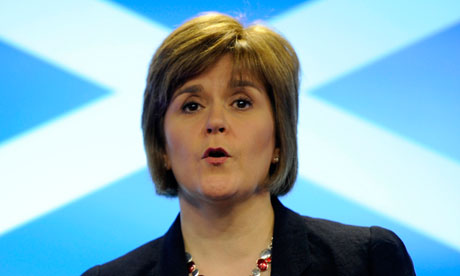
Now, one of the uncertain issues in the Scottish independence debate is what kind of intelligence agencies a new Scotland would create. Deputy First Minister Nicola Sturgeon told the Foreign Affairs Committee that an independent Scotland would create its own domestic intelligence agency, but that the Scottish Government was taking advice on establishing a foreign intelligence service like MI6. Members of the intelligence community have said that Scotland would also need some kind of ‘mini-GCHQ’ to defend against cyber attacks. Whatever the decision, an independent Scotland would not have the resources to replicate the advanced communications intelligence facilities of GCHQ. It would also be starting from scratch and so take years to establish credible capabilities.

This raises some questions. If Scotland is not going to monitor domestic communications like the UK government wants to, then will this leave an unsurveilled utopia of personal freedom north of the border? Could a would-be terrorist simply move to from London to Gretna to avoid having his or her communications monitored, then plan the next attack? And given that UK communication systems (land lines, mobile networks, internet infrastructure) are completely integrated, how would an independent Scotland implement a different legal regime for data protection and surveillance, even if it wanted to?

Here is a modest proposal. The US-UK intelligence sharing relationship shows us the way. An independent Scotland could simply allow GCHQ to spy on its citizens’ communications, then share the intelligence with the Scottish Government. This way, GCHQ would be spying on foreigners, the Scottish government could legitimately say that it does not monitor its own citizens’ electronic activities, and the UK security services would avoid the terrifying Gretna scenario.

So here are two questions for First Minister’s Question Time at the Scottish parliament: “Would the First Minister allow UK intelligence agencies to spy on the citizens of an independent Scotland? And would the Scottish government make use of the resulting intelligence?

Dr Andrew Neal is a Lecturer at the School of Social and Political Science at the University of Edinburgh. He blogs at securitypolitics and tweets @andrewwneal

Posted in Defence and Security | Leave a comment

SNP must set out their welfare vision

Dr. Nicola McEwen, Academy of Government

Dr. Nicola McEwen, Academy of Government

Nicola McEwen addresses the implications of independence on welfare provisions and reforms, and notes that shared service agreements recommended in the post-independence transition period might limit the degree of differentiation between the system of Scotland and the rest of the UK. 

Welfare reform has been a key focus of the campaign for Scottish independence. YES campaigners see the UK government’s welfare reforms – symbolised by the bedroom tax – as symbolic of all that is wrong with the Union, and an opportunity to mobilise support for independence.

And yet, the report of the independent Expert Working Group on Welfare raises questions about how different a Scottish welfare system under independence might be, at least in the early years. The report recommended that the Scottish and UK governments work together, in the spirit of the Edinburgh agreement, to deliver pensions and benefits on a shared arrangement basis for a transitional period.

Shared arrangements for delivering benefits might be sensible in the short term, but independence ought to provide an opportunity to do things differently. The challenge facing the Scottish government is to present a vision of a new welfare system for Scotland’s future.  

The rationale underpinning the recommendation is sound. The bodies delivering public pensions and benefits are all under the control of the UK government, but they are scattered across the UK. Most – though not all – benefits applied for by Scots are processed in Scotland. But offices in Scotland also provide this service to claimants in England. The Child Maintenance Service, based in Falkirk, processes applications for the north-east of England. Scottish-based DWP centres deliver working age benefits for applicants in Yorkshire, the North West of England and London. There are clear advantages – in terms of continuity of service to those dependent on welfare benefits and job security for those who deliver them – to shared service agreements even after independence.

But this would surely come at a price. Put simply, the greater the interdependencies and continuities, the less scope there is for doing things differently. Social security may be delivered across the UK, but the system itself is deeply integrated. Corporate functions and IT systems are managed centrally. Service delivery is dependent upon an integrated payment and accounting system run by the UK Department for Works and Pensions. This core engine at the heart of the system calculates benefit entitlements based upon a UK policy framework.

Such a system can accommodate relatively minor modifications, as in Northern Ireland. Social security is devolved in Northern Ireland, but it conforms closely to the system designed for the rest of the UK. This is linked to the pre-occupation with maintaining parity in entitlements, and retaining the Treasury subvention that comes with it. But the UK government’s welfare reforms have provoked debate about how far Northern Ireland can go its own way. Intergovernmental agreement will permit special arrangements around the delivery of payments – for example, to split payments within a household, provide bi-monthly payments, or payments direct to landlords. Even these minor changes require the design of a separate IT system for Northern Ireland to intercept with the core system once entitlements are calculated.

The Expert Working Group suggested that shared arrangements should be capable of accommodating any preliminary policy changes a Scottish government might want to introduce. But beyond tweaking the template, as in Northern Ireland, it is not at all clear how this might be achieved. How, for example, would the removal of the under-occupancy penalty on housing benefit – the bedroom tax – affect the maintenance of an integrated system of processing and delivery? In practical terms, it would be extremely difficult to share the administration and delivery of services in the context of markedly different entitlements north and south of the border.

Shared arrangements for delivering benefits might be sensible in the short term, but independence ought to provide an opportunity to do things differently. The challenge facing the Scottish government is to present a vision of a new welfare system for Scotland’s future.

Dr Nicola McEwen is Director of Public Policy at the Academy of Government, University of Edinburgh, and ESRC Senior Scotland Fellow. Her ESRC fellowship explores the opportunities and constraints of shared services and cross-border intergovernmental arrangements under independence. This piece was originally published in the 12 June 2013 edition of The Scotsman.      

Posted in Welfare and Social Policy | Leave a comment

Lost in Translation

William MacLeodDr Wilson McLeod scrutinises the place of the Gaelic language in the independence debate and criticises the Scottish Government’s ‘illogical’ decision not to issue a bilingual ballot paper in the referendum 

It is a commonplace that language plays only a small role in Scottish nationalism, in contrast to counterpart movements in Catalonia, Quebec and elsewhere. While this is an oversimplification, it is indisputable that language issues have not been prominent in the current debate over Scottish independence. There are also practical reasons for this limited attention, for the Scottish Parliament already controls most of the areas of policy in which language issues tend to arise, most obviously education and culture. Nor has there been an extensive debate conducted in Gaelic concerning the pros and cons of independence. Gaelic counterparts of pro-independence groups such as Yes Scotland have recently been set up on Facebook  and Twitter, for example, but have attracted few followers; by and large, Gaelic speakers, all of whom are bilingual, appear content to take part in (or ignore!) the mainstream English-medium debate.

Insisting on an English-only policy in relation to the momentous decision on independence is at best a missed opportunity, at worst a calculated derogation that goes against the stated policies of the Government and the Parliament to promote the language.

A potentially significant issue has recently come to the fore, however: should the referendum ballot paper be bilingual, presenting the question in Gaelic as well as English?

The Scottish Government has so far refused to authorise a bilingual ballot paper, angering many Gaelic activists and organisations. In response to a parliamentary question from Angus MacDonald MSP, the Deputy First Minister stated on 25 February 2013  that:

The Scottish Government does not plan to provide a Gaelic language version of the ballot paper for the independence referendum.

As part of the question assessment process, the Electoral Commission tested the proposed question with voters who speak Gaelic as a first language. The Commission found that these participants could understand the question easily and experienced no difficulties in completing the ballot paper. . .

Voter information will be available in other languages, including Gaelic, on request. Counting officers may also choose to display a translation of the ballot paper at polling stations if they consider this appropriate. This is standard practice for all elections.

The Deputy First Minister reiterated this position on 27 April in a letter to Angus MacDonald in his capacity as convener of the Cross-Party Group on Gaelic.

On 16 May, a petition demanding a bilingual ballot paper was lodged with the Scottish Parliament by Gaelic campaigner Iain MacLeòid, president of An Comunn Gaidhealach. The petition had attracted more than 700 signatures by its closing date on 5 June. The issue is now being taken up by the Scottish Parliament’s Referendum (Scotland) Bill Committee in its consideration of the referendum bill, most recently at the stage 1 debate on 23 May. In its written submission to the Committee, Bòrd na Gàidhlig, the statutory language board, expressed its disappointment at the Government’s position and submitted a draft version of a bilingual ballot paper, posing the question ‘Am bu chòir do dh’Alba a bhith na dùthaich neo-eisimileach?’ alongside ‘Should Scotland be an independent country?’ Other Gaelic organisations and supporters have lent support to this view, and there has been extensive discussion in Gaelic newspaper columns, blogs and other on-line fora.

The principal argument advanced by those demanding a bilingual ballot paper is that Gaelic speakers should be able to express their view on this historic referendum in their language of choice. The Gaelic Language (Scotland) Act 2005 has the aim of ‘securing the status of Gaelic as an official language of Scotland commanding equal respect with the English language’. An underpinning principle is that Gaelic should be legitimated and encouraged in Scottish public life generally. Insisting on an English-only policy in relation to the momentous decision on independence is at best a missed opportunity, at worst a calculated derogation that goes against the stated policies of the Government and the Parliament to promote the language.

Whatever the stated rationale for the Government’s position, it seems reasonably clear that political calculation plays a role. As part of its general strategy of endeavouring not to ‘frighten the horses’ in relation to the referendum vote, the Government may well fear that a bilingual English-Gaelic referendum paper could alienate some wavering voters who might (quite unrealistically) see Gaelic as some kind of nationalist totem. A number of Gaelic-speaking independence supporters have backed this view, arguing that the symbolic value of a bilingual ballot paper is outweighed by this political risk.

It is unfortunate that the issue of Gaelic in electoral materials was not dealt with at some earlier point, with bilingual ballots being introduced in a less momentous election and slowly normalised. In Wales, by way of contrast, bilingual Welsh-English ballots have been used not only in the 1979, 1997 and 2011 devolution referenda, but in all Assembly and local authority elections.

Perhaps the most problematic aspect of the Government’s approach to this issue has been the rationale provided by the Electoral Commission for not issuing a bilingual ballot paper: that all the Gaelic speakers who were shown the test ballot stated that they were able to understand the English version. (The Government rather than the Commission is properly to blame here, as the Government chose not to ask [p. 35] the Commission to test a bilingual ballot paper or a version with a Gaelic option). This argument completely misunderstands the rationale for Gaelic promotion in contemporary Scotland. All Gaelic speakers can speak and understand English – not least because of the government education policies from 1872 onwards that made almost no provision for Gaelic. Materials and services are not offered in Gaelic because Gaelic speakers cannot understand the English ones, but because Gaelic is recognised as a language deeply rooted in Scotland that is entitled to ‘equal respect’ under the law. The principle that no provision will be made for Gaelic except for those who cannot understand English is entirely out of keeping not only with the Gaelic Language Act but also with the European Charter for Regional or Minority Languages, which the UK Government ratified in 2001.

Were this principle to be adopted more widely, a wide range of promotional initiatives, in education, broadcasting and elsewhere, would need to be rolled back. For example, the Scottish Government (and many other public bodies) produce a range of written materials in Gaelic. Ironically, these include the consultation document on the referendum itself. It is obviously illogical for the Government to solicit the views of Gaelic speakers on the issue of independence through the medium of Gaelic and then insist that the final, determinative expression of their views be made in English. However, if the Government’s position is essentially an issue of political calculation, then principle and logic may not necessarily win the day.

Dr Wilson McLeod is Senior Lecturer in Celtic and Head of the Celtic and Scottish Studies Department at the University of Edinburgh 

Posted in Referendum process, campaign and vote | 9 Comments

Event: Nicola Sturgeon at the University of Edinburgh, tickets available

Nicola Sturgeon, MSP & Deputy First Minister

Nicola Sturgeon, MSP & Deputy First Minister

Independence: a renewed partnership of the Isles
Nicola Sturgeon MSP, Deputy First Minister
Date: Thursday 6th June 2013
Venue: Playfair Library Hall, Old College, South Bridge
Time: 6pm – 7pm

The event is free to all attendees but registration is required:
http://independencearenewedpartnershipoftheisles.eventbrite.co.uk


Posted in Events | Leave a comment