Podcast: Scottish governance under developing constitutional relationships

FutureUKThe Future of the UK and Scotland conference 2-3 May 2013 focused on the key issues facing Scotland and the UK in the run-up to and following the referendum of 2014. This podcast present the key issues highlighted in the Day 1 afternoon session.

Plenary session 2: Scottish governance under developing constitutional relationships
This session examines the feasibility of shared services, infrastructures and institutions, the governing arrangements necessary for co-ordinating them, and the likely power dynamics between governments. It looks at attitudes to independence and what forms them and give a regional and historical perspective on issues raised by the independence debate.

Speakers include Dr Nicola McEwen (University of Edinburgh), Professor James Mitchell (University of Edinburgh) and Professor Robert Young (University of Western Ontario).

Audio for the session is available here: http://www.esrc.ac.uk/publications/audio/future-of-uk-and-scotland-conference.aspx?media-component=tcm:8-26203&type=audio

Posted in Constitution, Events | 1 Comment

Navigating the debate

Jubilee Scotland's

Jubilee Scotland’

In this piece, Jubilee Scotland’s Charlotte Snelling explores the way in which charities understand their role in the debate over Scotland’s constitutional future. She argues that third sector organisations must engage with the debate in order to avoid the risk of being left behind in a post-referendum world but acknowledges the delicate balance they must maintain. 

With the referendum date now set and the prospect of a new constitutional arrangement seemingly moving closer to becoming a reality, politicians are finding themselves increasingly grappling with issues of what an independent Scotland, or alternatively a changed devolution settlement, might actually look like. Not only can we not predict yet which way the referendum will go but the nature of a post-referendum Scotland remains uncertain. An independent Scotland cannot simply be equated with the policies of a Scottish National Party-led government nor will a ‘no’ vote necessarily support the status quo. Disentangling party policies and promises from discussions of the constitutional debate – the opportunities and limitations associated within either option – is not an easy task.

Campaigning groups, in attempting to engage in the debate, find themselves entering dangerous water. Stick your head above the parapet and come out as for or against independence and you risk alienating many of your own supporters. Choosing the ‘wrong’ side may also leave your organisation’s position and influence weakened in the post-referendum landscape. Picking a side would also be far from straightforward. Even if your own organisation’s mission statement relates specifically to something which becomes or remains more achievable within one system above the other, one cannot get away from the fact that the constitutional debate itself is about a far wider range of issues. What might superficially appear to be the preferred option could, in the context of the wider settlement or policy programme of an in-coming government, actually present obstacles to achieving campaign goals. For example, a policy might expect to enjoy more political support in an independent Scotland but questions could remain over how it will be financed and the implications of this. Alternatively, campaigns which have the potential to affect a far larger number of people if based at a UK level, for example welfare policies, may be harder to achieve across a larger population and so become only a remote possibility without independence.

Campaigning groups, in attempting to engage in the debate, find themselves entering dangerous water. Stick your head above the parapet and come out as for or against independence and you risk alienating many of your own supporters.

Nevertheless, failing to engage with the debate and consider the possible future for your organisation and its campaigns risks being left behind in the post-referendum world. With so much focus on the debate in the political arena already, a decision not to engage further weakens any current ability to engage with politicians and policy actors and present a campaign vision in the here and now. A ‘business as usual’ approach in which campaigns are designed with no thought as to how they may need to adapt after the September 2014 vote is simply not viable. Jubilee Scotland is one organisation facing these issues.

Jubilee Scotland is a coalition campaigning organisation calling for the cancellation of unjust and unpayable sovereign debts and creation of a fair and transparent process to prevent the accumulation of such debts in the future. It believes that millions of people in some of the world’s poorest nations are having their life chances reduced by the burden of debts, debts which are often the result of irresponsible lending being made to dictatorial regimes, relating to weaponry or environmentally unsound projects, lacking in transparency, and going to countries which were clearly unable to repay them.

As a coalition movement with a diverse range of members including charities, faith groups, and civil society organisations, many of which possess their own missions and goals additional to those represented by their membership of Jubilee Scotland, the difficulties in agreeing to support one side of the independence debate above the other has been even more pronounced. How to engage with the independence debate has therefore been a key focus in recent months.

Jubilee Scotland has an ultimate objective to make Scotland a nation of debt justice, one in which Scotland holds no unjust or unpayable debts, is not implicated in the creation of any new unjust debts, and promotes debt justice internationally. From thinking about these goals within the context of the independence debate it has become increasingly apparent that none are incompatible with either an independent Scotland or a Scotland that is part of the UK. Rather they require different campaigning focuses and strategies in each context. Campaigning charities therefore need not be scared to talk more openly about the opportunities which might be presented in the case of either referendum outcome. Instead, Jubilee Scotland is able to present two ideal models relevant to a yes or no vote which will allow it to talk with both sides on considering how Scotland can become a nation of debt justice whatever the referendum outcome.

An independent Scotland, one which inherits a proportion of UK debt, presents an opportunity to conduct a full debt audit of Scotland’s debt arrangements and cancel all which are deemed to be unjust, representing a clear achievement of one of Jubilee Scotland’s principal objectives. However, remaining in the UK does not mean a Scotland free of unjust debts cannot be achieved. The only difference, however, is that this would require Jubilee Scotland putting pressure on the Scottish Government and Scottish MPs to lobby the Westminster Government to take this step for the whole of the UK. The former opportunity is perhaps a more realistic goal and would have the additional benefit of setting a global precedent from which more debts would hopefully be cancelled. It is not currently clear however how Scotland will inherit the UK’s existing debt arrangements and so whether it will be inherited in a form which could actually be audited and then cancelled. Moreover, within a devolved Scotland, a campaign to audit and cancel the UK’s illegitimate debts would, if successful, lead to the cancellation of a greater share of global debt. There are thus opportunities in both scenarios.

Similarly, under an independent Scotland a new export credit agency, from which many of these debts originate, would almost certainly have to be created. Jubilee Scotland would look to inform this process and ensure the agency follows the principles of the CUBE Manifesto to encourage responsible and ethical sovereign lending and borrowing. In this way, the build up of more unjust debt can be prevented. Alternatively, in a situation of devolution any renegotiation of the constitutional settlement could see Jubilee Scotland push for export credit powers to be transferred to Scotland alongside continuing its efforts with Jubilee Debt Campaign to reform the current structure and framework guiding UK Export Finance ensuring the UK, of which Scotland will remain, creates no new unjust debts itself

It is not Jubilee Scotland or any other campaigning organisation’s role to predict the future and determine the exact route through which their campaigns’ goals should be achieved given there is such uncertainty over what a post-referendum Scotland will look like. Nor should they be expected to take a side. It can be their role however to make sure they stay true to their campaign goals and explore how these might be pursued within each possible scenario, presenting both Yes Scotland and Better Together, as well as the current devolved government and opposition parties, with a framework for implementing change and, in the case of Jubilee Scotland, leading Scotland to become a nation of debt justice.

Jubilee ScotlandThis week sees Jubilee Scotland launch a new pledge campaign to draw attention to the devastating impacts of unjust and unpayable global debt and unite Scotland in a commitment to debt justice, one which is sustained whatever happens in September 2014. To find out more visit the Jubilee Scotland website, http://www.jubileescotland.org.uk.

Posted in General | Leave a comment

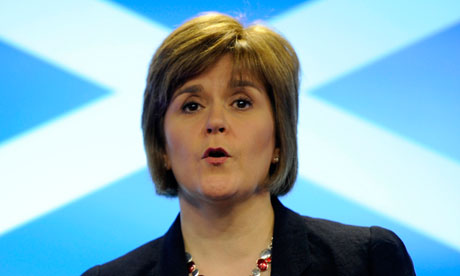
Event: Nicola Sturgeon at the University of Edinburgh

Nicola Sturgeon, MSP & Deputy First Minister

Nicola Sturgeon, MSP & Deputy First Minister

Independence: a renewed partnership of the Isles
Nicola Sturgeon MSP, Deputy First Minister
Date: Thursday 6th June 2013
Venue: Playfair Library Hall, Old College, South Bridge
Time: 6pm – 7pm

The event is free to all attendees but registration is required:
http://independencearenewedpartnershipoftheisles.eventbrite.co.uk


Posted in Events | Leave a comment

Event: Through the Public’s Eye

AQMeN

AQMeN

Through the Public’s Eye: Researching attitudes on Scotland’s constitutional future with the Scottish Social Attitudes Survey

The 2014 referendum on Scotland’s constitutional future has stimulated a vast amount of discussions. Many claims are made about what “Scots” want for the future, but too often these claims are not substantiated by empirical research. The Scottish Social Attitudes Survey (SSA) provides a valuable tool to assess the views of the public. In particular it can be used to track attitudes back to the late 1990s and analyse how the public’s views may have changed over time.

This one day event will showcase current research using this high-quality data source. In-depth findings on a range of topics will be presented by researchers from a variety of institutions in Scotland (both academic and policy-related). Research teams have worked together to provide responses to some of the most crucial questions about attitudes towards the constitutional future of Scotland – questions that will be important whatever the outcome of the referendum. In presenting their findings, these researchers will not only cast light on the current state of public opinion, but also examine how it has changed over the last 15 years.

This event will be highly valuable for anyone interested in the independence referendum and the future of Scottish public services and in particular public perceptions that shape the debates. It will also be useful for participants interested in the Scottish Social Attitudes Survey and its time series perspective. The event is open to practitioners and academics alike and does not require any prior knowledge.

Chair: Professor Susan Deacon, Assistant Principal, University of Edinburgh
External Speaker: Professor Charlie Jeffrey, University of Edinburgh

  • Professor John Curtice, University of Strathclyde/Scottish Centre for Social Research (ScotCen)
  • Rachel Ormston, Scottish Centre for Social Research (ScotCen)
  • Professor Lindsay Paterson, University of Edinburgh
  • Dr Jan Eichhorn, University of Edinburgh

Coffee and tea will be served in the morning and afternoon and a lunch buffet will be provided.

Wednesday, June 19, 2013 – 10:00 to 17:00
AQMeN
Our Dynamic Earth, Holyrood Road, Edinburgh

Register here.

Posted in Events | Leave a comment

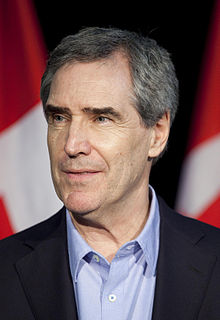
Event: Michael Ignatieff Lecture

Keynote Speaker: Professor Michael Ignatieff

Keynote Speaker: Professor Michael Ignatieff

Michael Ignatieff Lecture
‘The Crisis of Democratic Sovereignty’
University of Toronto / Harvard Kennedy School
23 May 2013, 5:30PM
Surgeon’s Hall, Edinburgh
Sponsored by The Global Justice Academy
Attendance is FREE. ALL WELCOME. Reception to follow

Conference also free for all Edinburgh participants – http://bit.ly/12mx5JC.
Registration with Simon.Kershaw@ed.ac.uk

Posted in Events | 1 Comment

In-out, shake it all about

Dr. Nicola McEwen, Academy of Government

Dr. Nicola McEwen, Academy of Government

The University of Edinburgh’s Dr. Nicola McEwen reflects on the implications of Ukip victories and the possibility of a referendum on EU membership for Scottish voters. This piece was originally published in the 14 May issue of the Scotsman.

Until last week, the risks and uncertainties highlighted in the referendum debate were stacked firmly on the Yes side.

The Scottish Government has been facing mounting pressure to answer questions on the implications of independence for a range of policies and cross-Border arrangements, from currency and pensions to defence and foreign affairs. None of these questions has a definitive answer. All are dependent on the outcome of negotiations, not just with the UK government but with the European Union, Nato and other international organisations. But raising the questions serves to augment the fear, uncertainty and doubt cast by those actively seeking to secure a No vote. The surge in support for Ukip in the recent local elections in England, and their strong performance in the South Shields and Eastleigh by-elections, has now turned attention toward some of the uncertainties surrounding a No vote, raising questions about the UK’s political and constitutional future.

Ukip’s success has already prompted a response from the UK government. Stricter immigration – the number one issue for Ukip voters – was at the centrepiece of last week’s Queen’s Speech at the State Opening of Parliament, with implications for who can work and access services across the UK. The Prime Minister, David Cameron, also felt compelled to reaffirm his commitment to hold an “in-out” referendum on the UK’s membership of the EU if re-elected to government in the 2015 General Election, amid pressures from his own back-benchers for an earlier poll.

Mr Cameron was forced to further clarify his position on this yesterday after Tory Cabinet ministers said they would vote to leave the EU as things stand. The prospect of an EU referendum raises the spectre that if Scots vote to maintain the Anglo-Scottish political union in 2014, it could involve withdrawal from the European Union.

Of course, the Conservatives would not be in a position to honour their EU referendum pledge if they were to lose the 2015 UK General Election. But it could become increasingly difficult for the other parties to resist similar pressures. There is strong support across the UK for an EU referendum, and the Conservatives are not the only party to face an electoral threat from Ukip. At the last elections to the European Parliament, when UKIP beat Labour into second place (in spite of coming sixth in Scotland), the British Election Study (BES) suggested that more Ukip supporters had voted Labour in the previous election than had voted Conservative. The BES monitoring survey also suggests Ukip is picking up support from disaffected Liberal Democrats. The European elections of May 2014 provide the next big electoral test. The issue of the UK’s future in or out of the EU, and the timing of a referendum on the issue, seems certain to stay close to the top of the agenda.

Scots, it seems, are more comfortable Europeans than their English counterparts.

The mere fact of holding an EU referendum does not guarantee that it would produce a vote for withdrawal. It is perhaps ironic that when, in January, Mr Cameron promised to hold a referendum on EU membership, the percentage of electors saying they would vote for Britain to leave the EU was outstripped by those who would vote to remain in the EU for the first time in over a year, according to the YouGov monthly tracker poll. More recently, though, support for leaving the EU is consistently ahead of support for staying – with a lead of between seven and 11 points.

Opinion in Scotland is markedly different. We may not be a nation of Europhiles, but an Ipsos-Mori poll in February suggested that a majority of Scots would vote for Britain to stay in the EU, outstripping those who would vote for Britain to leave by 19 points. Moreover, the poll showed a remarkable consistency of support for EU membership across most sections of society, and irrespective of party support – even Conservative voters in Scotland support Britain staying within the EU. Scots, it seems, are more comfortable Europeans than their English counterparts.

The consequences of UK withdrawal from the EU are at least as uncertain as the implications of Scottish independence. We might expect some form of agreement that continued to give the UK access to the single market, but the costs in terms of investment, trade, labour mobility and environmental and social protection are unclear, as are the implications of having to give up EU citizenship. The biggest potential losses may be in the capacity for influence within and beyond Europe, and yet the UK would still be affected by EU rules and decisions.

These debates on the UK’s future in Europe have become a key theme of the debate over Scotland’s future. In the past few weeks, several commentators have suggested that it could be a game-changer, shifting support towards a Yes vote to ensure Scotland remains within the EU.

The issue of the UK’s future in the EU has added an intriguing new dimension to Scotland’s referendum debate, raising yet more questions on the consequences of both a Yes and No vote. Whatever the outcome, we face an uncertain future.

There is no doubt that there are anxieties within civil society about the possibility of leaving the EU, and broad support within Scotland for EU membership whether or not Scotland becomes independent. But it is not clear that the threat of a referendum that could lead to withdrawal from the EU would outweigh the concerns or attachments that underlie the current inclination, according to opinion polls, towards a No vote in the independence referendum.

Moreover, the prospect of UK withdrawal from the EU also raises searching questions for the Yes campaign, especially when we consider the kind of independence being envisaged by the Scottish Government. The emphasis has been on a form of independence that would be embedded within the British Isles and the European Union. It is envisaged that Scotland and the rest of the UK would continue to share a currency, a common labour market, a common travel area, a shared electricity market, and a variety of other shared arrangements potentially including agreements on cross-border pensions and social security.

As it stands, many of these arrangements would require negotiated agreement not just with the UK government but also with the EU. For example, agreeing a common travel area with the rest of the UK would necessitate a negotiated opt-out from those aspects of the EU Schengen agreement pertaining to border control, visas and asylum. It is not too difficult to envisage such an agreement being reached while both Scotland and the rest of the UK remain within the EU – Ireland and the UK negotiated similar agreements on Schengen so as to maintain the UK-Ireland common travel area. But such agreements at the EU level could be more complex and politically difficult if the rest of the UK is no longer part of the EU family, especially if it imposed restrictions on EU citizens’ rights to live and work within its territory.

The issue of the UK’s future in the EU has added an intriguing new dimension to Scotland’s referendum debate, raising yet more questions on the consequences of both a Yes and No vote. Whatever the outcome, we face an uncertain future.

Dr Nicola McEwen is ESRC Senior Scotland Fellow, and director of Public Policy at the Academy of Government, University of Edinburgh. 

Posted in Europe and External Relations | Leave a comment

Event: The Future of Scotland

AQMeN

AQMeN

The Future of Scotland: Attitudes of 14-17 year olds on the Scottish independence referendum

Wednesday, June 5, 2013 – 12:30 to 15:00
Hosted by AQMeN
Royal College of Physicians, 9 Queen Street, Edinburgh

During this event results from the first representative survey of 14-17 year olds in Scotland regarding the 2014 independence referendum will be presented. Funded by the Economic and Social Research Council (ESRC) a team of researchers from the University of Edinburgh has designed and conducted a Scotland-wide survey of this age group. The understanding of their views is crucial, considering the lowering of the voting age to 16 for the referendum which will see most people in this age group able to cast their vote. So far there has not been a comprehensive and representative survey of this group.

This event will provide the first opportunity to engage with the results from the breadth of themes covered in the survey. The project does not simply provide a poll on the main referendum question, but sets of questions addressing themes relating to:

  • Views on the idea of an independent Scotland
  • Attitudes towards politics
  • Perceptions of national identity
  • Differences in socio-demographic background
  • Parental views on an independent Scotland

The questions used in the survey are based on existing large-scale adult surveys, but have been piloted also in a school with 110 pupils allowing the research team to refine the questions to become more meaningful to young people. Some reflection on the views from those involved in the pilot will be presented as well. After the presentation of the results there will be substantial room for discussion and an outlook for further work with this data

Attendance is free for AQMeN members however, places are limited and you must register here.

Posted in Events | Leave a comment

Debating a Scottish Currency

Dr. Robert Zymek, University of Edinburgh

Dr. Robert Zymek, University of Edinburgh

In the first of a series of monthly blogs on the independence referendum from Edinburgh University’s School of Economics, Dr. Robert Zymek weighs up the practical considerations around the currency arrangements of an independent Scotland.

The politics of Scotland’s currency arrangement pose a conundrum for advocates of independence. On the one hand, polls show overwhelming support among Scottish voters for keeping the pound. Chancellor George Osborne seized on this when, on April 23, he suggested that England, Wales and Northern Ireland could veto a currency union with a newly independent Scotland – a scenario that may deter potential Yes voters in next year’s referendum. On the other hand, retaining the pound may trap Scotland in an uneasy live-in arrangement with the rest of the UK. The No campaign has exploited this inconsistency, with Alistair Darling declaring that such a currency union would “undermine Scottish independence”. The SNP’s official response has been to argue that a formal currency union between Scotland and the rest of the UK – a so-called Sterling zone – would be in the interest of both countries if Scotland were to become independent. (See also Alex Salmond’s article in the 5 May 2013 edition of the Mail)

While the question of an independent Scotland’s choice of currency is hard to disentangle from political strategy as the referendum campaign heats up, it is clear that the eventual nature of the currency arrangement would have profound implications for the Scottish economy. In this post, I will explore the pure economic angle on this choice, conveniently leaving political and legal considerations aside.

Shocks

In principle, Scotland could opt for one of three currency regimes: i) keeping the pound – unilaterally or as part of a formal currency union with the rest of the UK; ii) joining the euro; or iii) setting up its own currency. To evaluate these options, it is useful to refer to the “Theory of Optimum Currency Areas” which was developed by the Canadian economist Robert Mundell in 1961 (and which helped win him the Nobel Prize in 1999).

Such dynamic considerations mean that the optimal currency arrangements cannot be chosen based on historical market integration and business-cycle synchronisation alone. An independent Scotland’s choice of currency should also reflect its intended place among the economies of Europe.

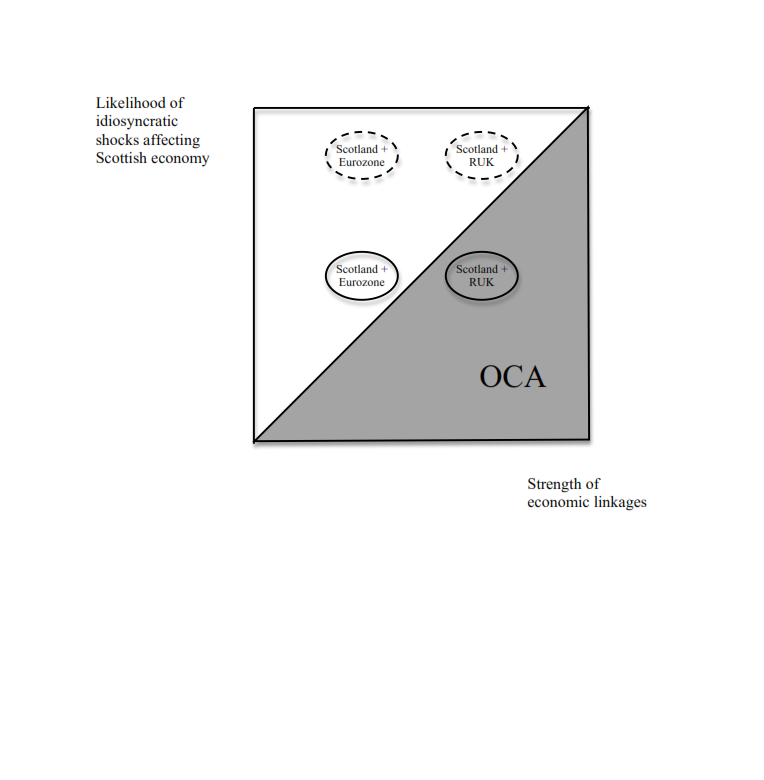
Mundell showed that two regions were more likely to form an Optimum Currency Area (OCA) if they had strong trade and financial linkages, and if their cycles of boom and bust coincided. The first part of the argument is straightforward: the more two countries trade with one another, the more damaging is the risk of sudden movements in the exchange rate, and the more beneficial the stability guaranteed by a common currency. The second part follows from the fact that two countries which share a currency must also share a central bank: the bigger the differences in economic conditions in different parts of the currency area, the more difficult it is for the central bank to set interest rates so as to provide economic stability for the area as whole.

How can these criteria inform Scotland’s optimal currency choice? At present, the Scottish economy is much more tightly integrated via goods trade and capital flows with the rest of the UK than with the Eurozone. At the same time, there are major economic shocks – most notably a decline in the oil price – which could put Scotland’s business cycle out of sync with both regions. The question is how likely such shocks are. The diagram below illustrates this point. If the risk of an economic shock affecting Scotland alone is low (solid circles), Scotland and the rest of the UK may represent an OCA due to their strong economic linkages, but Scotland and the Eurozone may not. If the risk of a Scotland-specific shock is high (dashed circles), it may be best for Scotland not to share a currency with either region.

Even in the latter case, Scotland may prefer to be part of a Sterling zone rather than the Eurozone. Thanks to an open border and common language, Scottish workers can easily move Southward in search of jobs, and Scottish savers are heavily invested in English banks and companies. This insures firms and workers against an isolated downturn in the Scottish economy.

Closer social and economic ties can thus serve as a substitute for synchronised business cycles in a currency area. Yet these ties are themselves affected by currency arrangements: if Scotland were to ditch the pound and join the Eurozone, new economic links with its Euro partners would likely crowd out some of the current trade and migration between Scotland and the rest of the UK. Over time, Scotland and the Eurozone could gradually evolve into an OCA, while Scotland and the rest of the UK might grow apart. Similarly, an independent Scotland issuing its own currency (which should be called the “Bawbee”, according to economist John Kay, in reference to a coin first issued by James V) may drift away economically from both the rest of the UK and the Eurozone.

Such dynamic considerations mean that the optimal currency arrangements cannot be chosen based on historical market integration and business-cycle synchronisation alone. An independent Scotland’s choice of currency should also reflect its intended place among the economies of Europe.

Next month, my colleague David Comerford will take a closer look at the constraints a hypothetical Sterling zone would impose on Scottish fiscal and prudential policy after independence.

Dr. Robert Zymek is a Lecturer in Economics at the University of Edinburgh. 

Posted in Economy and Currency | 2 Comments

Bannockburn and all that

Dr. Gordon Pentland, University of Edinburgh

Dr. Gordon Pentland, University of Edinburgh

Dr Gordon Pentland, academic historian at Edinburgh University, reflects on the political role of commemorations in the referendum campaign, and the need for skepticism about the claims to history made by all sides.

The relationship between politicians and history is seldom brought into starker relief than over the vexed and related issues of commemoration and history education within schools. Both of these are likely to form a significant part of the background noise to the referendum debate as it develops. To take commemorations as an example, it did not take long after the referendum became a certainty for speculation to emerge that the Scottish Government would try to achieve some kind of ‘Bannockburn bounce’ by tying the date of the vote into the 700th anniversary of the battle. Now that we know the real date, of course, such speculations have been quashed. Nevertheless, the ambitious plans for the commemoration of the battle, with a new state-of-the-art visitor centre and the now compulsory creation of a ‘brand’ (inanely described by its architects as ‘a visual identity that was both brutal and playful, full of meaning yet instantly accessible, and fresh without eschewing tradition’) means that accusations that the SNP are seeking political capital from this particular aspect of the Scottish past are unlikely to disappear. As the digital clock counts down the 700 days to the 700th anniversary, claims that nationalists are somehow not to be trusted with history will provide a constant refrain in the independence debate.

history… is such a powerful resource that no one interested in political power and in mobilizing people can afford to give it up completely. All politicians, regardless of their affiliations… make claims to certain ‘national histories’, whether they are aware that they are doing so or not.

Such claims – echoing the late Eric Hobsbawm’s famous assertion that ‘no serious historian of nations and nationalisms can be a committed political nationalist’ – are apt to be far louder and shriller than any directed at countervailing commemorations. In particular, the ambitious plans to mark the centenary of the outbreak of the First World War surely represent an opportunity to underline a shared British experience if ever there was one and David Cameron has hailed: ‘A commemoration that captures our national spirit in every corner of the country’. This planned commemoration (much closer to the actual date of the referendum than the Bannockburn anniversary) has not attracted anywhere near the same level of grumbling in the press. The nature of the conflict – far closer in time and involving a far more profound and widespread sense of loss – makes it difficult, taboo even, to suggest that the motives behind or the effects of its commemoration might be construed as political. Whether intentional or not, however, all such events, which involve politicians, state bodies and claims to ownership and understanding of the past are inescapably political.

Indeed, such politicized debates over Scotland’s past and its relationship to the British past have become increasingly frequent since devolution and do not require events as starkly polarizing as Bannockburn or as transformative as the First World War to sustain them. One revealing example, which sits on the threshold between issues of commemoration and education, was a debate in the Scottish Parliament in 2001. The motion put was that the deaths of James Wilson, John Baird and Andrew Hardie – three men executed for their role in an abortive radical insurrection in 1820 – be incorporated into the education curriculum as a means of commemorating their sacrifice. In the subsequent debate, this event became a pivot for three competing narratives: the Nationalist (that these men should be commemorated primarily because they died ‘in the cause of Scottish self-determination’); the Labour (that they should be commemorated to demonstrate that ‘The real heroes in Scottish history are not the kings … but the ordinary working-class people’); and the Conservative (that they should not be commemorated because ‘we would be wise to teach the lessons that the nation has learned from that history rather than glorifying men who betrayed it’).

The point surely is that history (understood in its broadest sense as claims to knowledge about ‘the past’) is such a powerful resource that no one interested in political power and in mobilizing people can afford to give it up completely. All politicians, regardless of their affiliations to different political parties and positions, make claims to certain ‘national histories’, whether they are aware that they are doing so or not. And they make these claims as academic historians have increasingly moved away from their own traditional role in furnishing histories of the nation. So the advice from this particular academic historian is to treat all statements about history coming from the mouths of politicians and from ‘Yes’ and ‘No’ campaigns with a healthy skepticism. To be plausible, they must all have an kernel of truth in them; but they are far more likely to live up to Ernst Renan’s famous dictum that: ‘Forgetting, I would even go so far as to say historical error, is a crucial factor in the creation of a nation’.

Dr Gordon Pentland is a Senior Lecturer in History at the University of Edinburgh. He is author of The Spirit of the Union: Popular Politics in Scotland, 1815-1820, published in 2011.

Posted in History | Leave a comment

Event: The Political Histories of Modern Scotland

Evening SaltireThe Political Histories of Modern Scotland with Professor Ewen A. Cameron

Date: Tuesday 7 May 2013
Time: 5:15 pm
Venue: Auditorium Lecture Theatre, Business School

The current debate on ‘independence’ for Scotland has provided a recent focus on the clash between nationalism and unionism. The lecture will argue that there is a danger that the nature of this debate leaves us with an overly narrow understanding of the richness of modern Scottish political culture. The lecture will explore the different traditions which have been evident in modern Scottish political history, the sources which historians have used to study them and the extent to which the recent emphasis on the imperial and global dimensions of Scottish history can be augmented by consideration of politics.

Posted in Events | Leave a comment